Thursday, November 02, 2006

Guest Post: My Libertarian Propositions

A Dialogue With A Liberal
By Arnold Kling, October 13, 2006

"Consider this an invitation. Are these propositions meaningful? Are they helpful? Are they simply wrong? As a liberal, how would you change them or modify the list? As a conservative, how would you draft a similar list for conservatives?"

-- Geoffrey R. Stone, What it Means to be a Liberal


I will take up this invitation University of Chicago law professor Geoffrey Stone, speaking not for conservatism, but for my own brand of libertarianism. First, let me comment on a couple of his propositions.

Stone writes,

Liberals believe individuals should doubt their own truths and consider fairly and open-mindedly the truths of others...Liberals are skeptical of censorship and celebrate free and open debate.

I agree that this is the liberal ideal. In my experience, liberals are not as open-minded as I would like, but open-mindedness is a difficult ideal to uphold. I am pleased to see open-mindedness listed first.

Later, he writes,

Liberals believe government has a fundamental responsibility to help those who are less fortunate. It is liberals who have supported and continue to support government programs to improve health care, education, social security, job training and welfare for the neediest members of society. It is liberals who maintain that a national community is like a family and that government exists in part to "promote the general welfare."

I believe that in reality what has helped the less fortunate is economic growth. Today's elderly are affluent not because of Social Security, but because of all of the wealth created by private sector innovation over their lifetimes. Government involvement in health care and education is an impediment to progress in those fields. Job training and welfare are demonstrable failures. I think that treating a national community like a family is a grave intellectual error. A national unit is an institution that creates a legal framework for a large group of strangers to interact. A family is a small group that interacts on the basis of personal bonds. Strengthening government serves to weaken families and other vital civic institutions. If Professor Stone is truly as open-minded as he says, then he ought to examine what economists have found about the sources of economic growth and the ways that poverty has been alleviated over time.

My Libertarian Propositions

1. Liberty is important for its own sake. People are entitled to make their own choices.

2. There are other values in addition to liberty. However, many noble causes end up infringing on liberty without achieving their desired ends. Government policies should be evaluated on the basis of their consequences, not on the basis of how they make us feel. It may feel good to set a minimum wage, to impose rent control, or to declare a war on drugs, but the evidence is that such policies tend to work to the detriment of their intended beneficiaries.

3. I value relieving the suffering of others. However, compared with liberals, I have considerable humility when it comes to advocating taking other people's money in order to satisfy my urge to alleviate poverty.

4. Corporate power is adequately checked by market forces. Competitors are the main force protecting consumers. Alternative job opportunities are the main force protecting workers. For corporate power to be a threat, it must be allied with government power.

5. We would be better off with much less regulation. I will grant that some forms of deregulation, such as eliminating meat inspection, appear to have risks that outweigh the potential benefits. On the other hand, many forms of deregulation, such as eliminating licensing restrictions for medical practice, have potential benefits that outweigh the risks.

6. Government is just one of many institutions for collective action. There also are trade associations, civic associations, religious groups, charities, and many other organizations that can provide collective goods.

7. Government's unique institutional characteristic is the legal use of coercive force. This creates enormous potential for abuse, and indeed, there are many countries where government abuses its powers constantly, to the severe detriment of the population. The abuses are less evil in the United States, but where liberals look at government expansion and see opportunity, libertarians see threat.

8. Providing for the common defense is a legitimate function of government.

9. There is no such thing as the "international community," only a constantly-changing array of allies and adversaries. The United Nations serves mainly to prop up authoritarian regimes. The European Union is a bureaucratic nightmare. The United States should be proud of our ideal of liberty, especially economic liberty.

10. In a world where small, covert operations (also known as terrorism) are a significant threat, government needs to use the tools of surveillance. However, surveillance power must be subject to checks and balances that are beyond those currently available.

Arnold Kling is author of Learning Economics.

Governments Oppose Things That Work

Courtesy of Coyote, we submit this,
via Neal McCluskey at Cato:

District officials, as well as the president of the teachers union, bristle at assertions by the Charter Schools Association that middle and high school charters are significantly outperforming their district counterparts.

A fairer comparison would be with the district’s magnet schools, which outperform charters, school board member Jon Lauritzen said.
“I think it’s basically unfair to compare an entity that is able to take their entire budget and focus it entirely on their own schools,” he said. “They have some real advantages over our schools in the flexibility of actually providing the type of education that a particular community wants, whereas we are trying to provide a curriculum that works for everyone all across the school district.”

This last paragraph is hilarious on its face. The average parent must wonder what Mr. Lauritzen is doing with the public school funds in contrast to focusing his entire budget at, you know, the schools, like those evil competitors do. And what government official would ever be caught dead providing the type of serves that a particular community actually wants. And this is all in the context that charter schools are, in McCluskey's words, a "pale shade of choice."

So, what does the teachers union and school board members do in the face of competition that they acknowledge works better? Do they demand the same flexibility in spending and rules in their own schools? No! Of course not! They demand that the schools that work better be eliminated:

It’s no wonder that, a few months ago, Mr. Lauritzen proposed a moratorium on charter schools, and that public schooling’s defenders fight even harder against reforms like vouchers and tax credits. After all, who could just sit by and watch parents get schools they want when an old, hopeless system is suffering?

Wednesday, November 01, 2006

Ahh, John Kerry - Ya Gotta Love Him

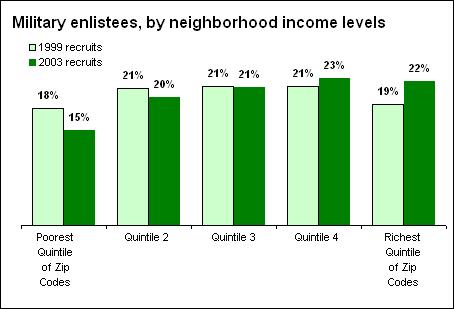
Senator Kerry stepped in it again and his timing was pretty bad. We think we can accept that he was trying to slam President Bush (although his own university performance was rather lackluster "his own self") and blew the joke. Never the less, it provides an opportunity to examine the myth, promoted by anti-military types, that the poor make up the majority of those that serve.


The facts simply don't bear this out:


The military really doesn't ask how much money your parents make when they sign you up. However, they do ask you what zip code you are from, and this analysis seems to belie the assumption, showing the army is actually made up disproportionately of recruits from the richest rather than the poorest zip codes.

Tuesday, October 31, 2006

Halloween Gets The Ax


Halloween gets the ax:


"School crime was dealt a sharp blow in Pittsburgh, Pennsylvania, when Jordan Locke was suspended for bringing an ax to school. In an open letter to area media, Superintendent Joel Carr and school board President Thomas DeBolt wrote, 'As administrators of schools, with the safety of hundreds of children in mind, it is also our job to protect lives, too!'

"The incident was controversial because: 1) Jordan is five years old; 2) his ax was five inches long and made of plastic; and 3) it was part of his Halloween costume. Jordan dressed as a firefighter. He was suspended for violating a district policy that prohibits weapons - real or toy. Firefighters objected to their tool being labeled a weapon, prompting Carr and DeBolt's open letter apologizing for the incident."

Abentee and Early Votes More & More Important


Early voting has grown in the past 15 years, from around 2% of the national electorate participating to about 20% in 2004. Experts predict this year that 19% to 25% of the electorate will vote early at the polls or by mail-in absentee ballots. That compares with about 14% in 2002, the most recent midterm election.

Fueling the trend toward early voting, 30 states now allow unrestricted absentee voting, with 15 , including Illinois, allowing early voting in person at county-clerk offices and polling areas.

These votes, by definition, cannot be included in media "exit polling", so don't listen to the exit polling data which you'll hear throughout election day. They don't mean squat.

If you didn't vote early (and often, as a friend of ours likes to say), go ahead and get to the polls on election day, November 7th, regardless of whether you think your vote will "make a difference" or not.

We know it will.

The True "October Surprise"?

One week from today the votes will be tabulated and all of the guessing will be over!

The Mike Allen report lays out some interesting last minute information:

Top Republican officials believe the GOP will keep both houses of Congress next Tuesday, and they have five good reasons to think so (in addition to Bush's residual popularity in some crucial states and districts:

1) No Republican is being taken by surprise, unlike many Democrats in 1994. Shortly after Bush's reelection, White House and Republican National Committee officials began working to convince House members that the formidable reelection record for incumbents (since 1996, 97.5 percent) was not something they could take for granted. "What we attempted to do last year," said one of these officials, "was to go out of our way to say to people: 'You face a potential of a race. In order to win as an incumbent, you better have a plan,' " including an intensive focus on voter registration, a message plan that would unfold in phases, and a ground organization that was operating in a measurable, quantifiable way. One official involved in the process said Republican officials deliberately "scared" lawmakers, telling them: "You face a very tough road. You better be ready."

2) Absentee ballot requests and returns, closely tracked by the party, are meeting or exceeding past levels for Republicans in key states and districts. Republican officials say White House Deputy Chief of Staff Karl Rove and party operatives are scrutinizing this data with the same intensity that they followed metrics like voter registration earlier in the cycle. For at least 68 races, they have been getting reports once a week on the number of voters registered, phone calls completed and doors knocked on. Now, they're getting a second report on the number of absentee ballots requested, absentee ballots returned and early votes cast. "We can look at that data flow and make an assumption about what's going on and plotting it out," a Republican official said.

3) When the national parties, national campaign committees, state "victory" committee accounts and competitive campaigns are added up, Republicans maintained a substantial financial advantage over Democrats at the last filing period. "We didn't look on it as one pot," said one official involved in the process. "We looked upon it as four pots, with synergy available through all four."

4) Republicans say the district-by-district playing field favors them in several structural ways not reflected in national polls. Here is their thinking, starting with statistics from the President's 2004 race against John F. Kerry: "There are 41 districts held by a Democrat that Bush carried, and 14 seats held by Republican that Kerry carried, so we're fighting on better turf. You see it in the open seats, where Bush carried 18 of the Republican open seats and Kerry carried two. So we're fighting on better turf."

5) The get-out-the-vote machine designed by Rove and now-Republican National Committee Chairman Ken Mehlman in 2001 was dubbed the "72-hour" program, but officials say that's quite a misnomer and that it's really a 17-week or even two-year program. "In Ohio, we are making more phone calls this year than we made two years ago," said an official involved in the process. "Now, that's not the case necessarily in Virginia, which was not a battleground state. You have to build that. In other places, we built that and built it early."

Don't touch that dial!

Wednesday, October 25, 2006

Recent Illinois Races Fund Raising Efforts


This bulletin arrived today from our good friend Bob H.:


Here's a snapshot of money raised in top local races over the past 16 weeks. Totals include all contributions from July 1-Oct. 8, and donations of more than $500 received since Oct. 9.

GOVERNOR

Rod Blagojevich, Democrat, $3,492,109

Judy Baar Topinka, Republican, $3,707,499

Rich Whitney, Green, $24,519

LT. GOVERNOR

Pat Quinn, Democrat, $60,524

Joe Birkett, Republican, $460,992

ATTORNEY GENERAL

Lisa Madigan, Democrat, $672,011

Stu Umholtz, Republican, $42,713

SECRETARY OF STATE

Jesse White, Democrat, $344,167

Dan Rutherford, Republican, $316,948

COMPTROLLER

Dan Hynes, Democrat, $338,391

Carole Pankau, Republican, $122,843

TREASURER

Alexi Giannoulias, Democrat, $2,193,211

Christine Radogno, Republican, $552,340

COOK COUNTY BOARD PRESIDENT

Todd Stroger, Democrat, $638,515

Tony Peraica, Republican ,$407,229

Saturday, October 21, 2006

"Tax swap" won't cut taxes or help schools

Guest "blogger":

October 21, 2006
BY MICHAEL VAN WINKLE

The Rev. Jesse Jackson led a rally at the Thompson Center last Saturday, officially jumping on board the education funding reform bandwagon. The rally was held to show support for Senate Bill 750, which Democrats will likely try to push through the General Assembly during November's veto session.

Jackson and Co. complain that our education funding system relies too heavily on property taxes, an arrangement they claim leads to vast inequities in available resources between rich and poor school districts. The bill purports to solve the problem by providing property tax relief in exchange for higher income taxes that would fund an increase in education spending. Proponents claim the ''swap'' would enable the state to increase its share of education funding, reduce the schools' reliance on property taxes and increase the overall equity of school funding.

Sounds great, right? Who could possibly say no? Unfortunately, the details of the bill expose the superficiality inside. Here are a few reasons we should forget about S.B. 750:

1. Education funding disparities are mostly irrelevant because spending differences between districts are not a good indicator of school quality. Spending differs across school districts for a variety of reasons. Not all low-spending districts are poor and not all high-spending districts are rich. Disparities are not themselves proof that someone is being denied access to quality educational opportunities.

2. There are a few cases in which funding gaps might matter, but S.B. 750 is not designed to fix them. The legislation being considered will not take money from overfunded schools and give it to underfunded schools. It will take money from all taxpayers and give it to all schools by increasing the ''foundation level'' support. It pays no regard to which might need more money and which might not.

3. Education funding reform does nothing to address problems with the allocation of education resources, particularly teaching. Teachers are paid on a strict union salary scale. Teachers also earn seniority -- which gives them, effectively, the ability to choose where they want to teach. Not surprisingly, most want to teach in schools where students have fewer educational and behavioral challenges. Because schools have no real freedom to offer higher pay for challenging environments, the net effect is that the most qualified teachers generally end up where they're needed least.

4. Despite being proffered as a tax swap, S.B. 750 is no such thing. The alleged property tax relief is an illusion. Taxpayers will actually get a property tax abatement, to be paid out of a fund into which roughly $2.4 billion of revenue generated by the income tax increase will be dumped. This fund will then be used to pay a portion of your property tax bill every year.
Your tax rate will not go down. The first time an economic recession hits and income tax revenues are not enough to fill the tax relief fund, the state will cry broke and you will once again be expected to cover the full balance of your tax bill.

5. There is insufficient oversight of school budgeting, which means there is no way for taxpayers to know whether the extra $1.6 billion S.B. 750 gives to schools will be spent on teaching kids or refurnishing the principals' offices.
To monitor how your district spends its cash you will have to attend countless school board meetings, make endless phone calls and probably file more than a few Freedom of Information Act requests. Will you get any help from the Illinois State Board of Education? Do I have to ask?

The state doesn't expect you to take it upon yourself to audit Central Management Services or the governor's office -- there is an auditor general for that. But when it comes to auditing your school, you're on your own.

I applaud Jackson and Co. for keeping education reform a topic of discussion, but their tax swap will only increase the cost of failure. To talk about education funding reform without also discussing accountability, standards, oversight and performance is a waste of time. And time is something many Illinois schoolchildren are running short on.

Michael Van Winkle manages media relations for the Heartland Institute.

Tuesday, October 17, 2006

"First Responder" Pork

The Daily Pantagraph today reports on a federal Department of Homeland Security grant for the city of Pontiac.

Would someone please tell us why the heck the Department of Homeland Security is sending money to municipalities to help relieve their fire department "overtime" problems?

Precisely how does this impact the general safety and welfare of the American people?

Or could it just be pork sandwiches for all?

Imagine the cartoon-like steam coming out of our ears as you read this piece from last April in the Washington Times.

Voters, Procrastinators, UNITE!

This year Illinois has joined the 34 other states which allow "early voting". These early votes are recorded but not counted until every other vote is counted on election day. Then and only then are absentee ballots and early ballots counted.

Now, can you tell us why "exit polling" data was so far off in the last presidential election? Don't believe the exit polls.

Don't believe these pre-election polls either. The paradigm has changed with cell phone emergence and the lack of public interest in responding to polls and surveys in general. What you're left with is a sub-group of fanatics that WANT to be polled.

Under no circumstances allow any media information to deter you from recording YOUR vote, be it absentee, early, or at the polling place on Election Day!

Saturday, October 14, 2006

Just Vote!


Try to ignore the incredibly negative campaigning and advertising out there this election season, overcome your disgust, and get out and VOTE!

It's easier than ever this year. The State of Illinois has inaugurated what is called "early voting", which means you can vote at your designated location (usually the County Clerk's Office) beginning next Monday, October 16th through Thursday, November 2nd. After that, you must vote on election day which is Tuesday, November 7th this year (unless you obtain an absentee ballot).

Re-elect your incumbents or "throw the bums out" - we don't care as long as you excercise the right to vote. Next, become involved in your local political scene through your municipal, county, and taxing authorities' meetings as much as you can. It's a sad fact that real political power these days lies not so much in the vote as in the passage of budgets and laws.

As an aside, contrary to all of the County Administrator and media hand wringing, it is our prediction that Woodford County will indeed have a wind farm. Not to worry, we'll "grow" that power for Chicago - as long as the price is right.

Saturday, September 23, 2006

"All Kids Illinois" health insurance


Well, it's been a month since our last post.
This is primarily due to our disgust and disillusionment with politics in general and "the media" in specific.
That being said we must tell you about this "Health Care for All Kids" in Illinois scam.
We just "applied" for enrollment in the program online.
Apparently "health care for all kids" only applies to those kids that have not been insured for a year.
Now we certainly aren't wealthy, but we have scrimped, saved, and sacrificed to provide health insurance for our kids. We shall now be penalized for this.
Now, if we can't prove our citizenship, we just sign something and we're put right through into the program.
If we divorced and just lived in the same residence we would be put right through.
If we were Black, Hispanic, or "Native American" (which, actually, we are - although we can't join the tribe without historical documentation which doesn't exist [gambling money with the tribes, don'cha know]) we'd be put right through into the program.
Here's our point - those who play by the old tried and true rules will receive no help. Those who play by the "new" cultural rules, which seem to reward selfishness, pettiness, and "Balkinization", will get all the "help" which they can stand.
As for us, we'll continue to pay cash for our health care; and we'll continue to treat our doctors, dentists, and nurses like we treat our auto mechanic, lawn-care guy, and HVAC folks - with respect, as friends, and trust them to take care of our needs.
We don't need no stinkin' help from Springfield, thank you very much. In addition, we won't even complain about our tax dollars going to Chicago and East St. Louis to subsidize health care for whoever qualifies. That's just the way we are.
But we don't have to like it.

Saturday, August 26, 2006

Schools: Give Us Money; We MIGHT Reduce Fees


We don't pretend to know all of the ins and outs of the Fieldcrest Referendum. We do know ridiculous school administration rhetoric and threats when we hear them:

According to Superintendent Randall S. Vincent, the board has promised to reduce those fees by at least 50 percent if an education tax rate referendum passes in November because, according to a district survey, school fees are a primary concern for those in the community..
"I don't think the fees will ever go away but we can bring them down to the level of other communities in our area," he said. " ... If the referendum passes, the board will definitely cut (participation) fees by 50 percent, but they may do more. If we are in better shape, I'm sure they will consider it (cutting fees further)."

So, in other words, "you can pay me now or you can pay me later, but YOU WILL PAY ME; and if you vote down a referendum, your 'fees' will go up and up and up and we'll still come back again and again and again with referendums 'till we get one passed. You got a problem with that?"

Tuesday, August 22, 2006

Zogby: Americans Demand Vote Transparency


A new Zogby poll released today shows that 92% of Americans believe that the public has the right to view and verify the counting of votes.

Choosing between "Citizens have the right to view and obtain information about how election officials count votes" or "Citizens do not have the right to view and obtain information about how elections officials count votes," 92% of those polled agreed with the first statement, 6% agreed with the second, and 2% were unsure.

The issue of transparency has become particularly important due to the use of electronic voting systems, most of which use proprietary code and do not allow for public inspection. This is obviously a formula for vote tampering.

Monday, August 21, 2006

Muslim Choice


Two quotations jumped out at us this past week:

"He who wrongs a Jew or a Christian will have me as his accuser on the Day of Judgment."
— Prophet Muhammad

and

"Allah never changes a people's state unless they change what's in themselves"
— Qu'ran (13:11)


No comment from us seems necessary.

Police Need Help?


We have yet to read the "petition" Henry County Sheriff Gib Cady initiated last week asking oil companies to help cut police fuel costs, but we think it's a good idea which doesn't go far enough.


Let's also have petitions to "Big Coffee" and Big Donuts" asking for relief on the outrageous expenses in these areas.


While we're offending our heroic first responders, we find the Woodford county volunteer firefighters demand that Navitas (the wind farm developer) provide about $125,000 to "train" a team of firefighters in handling farm related "emergencies", and buy equipment a little silly. By this logic, any company coming into the County should pay off the firefighters, police, and ambulance services.


Speaking of the wind farm - if the Townships (Greene, Clayton and Panola) are concerned about their roads, and want to work out a side agreement with Navitas, that's fine; however, let's not expect Navitas to pay for the Townships' attorneys to fight with them. That seems to be stretching things a bit, doesn't it?

Saturday, August 19, 2006

Congressional Mystery "earmarks" (pork)

The U.S. Congress is considering a bill — the Labor, Health and Human Services appropriations measure — that presently contains 1,867 earmarks worth more than a half-billion tax dollars and averaging nearly $268,000 each. Many are for things that sound like worthy causes such as "hospital facilities and equipment," yet none of the sponsoring congressmen put their names on their earmarks, and the specifics are fairly lacking in every instance.

And the winners are - for Illinois, which total $20.83 millions:

$700,000
Joliet
Joliet Junior College for the Integrated Systems Technology program

$500,000
Aurora
Rush-Copley Medical Center for facilities and equipment

$500,000
Peoria
Bradley University, for facilities and equipment for the Collaborative Health and Education Center

$500,000
Peoria
Children's Hospital of Illinois, for facilities and equipment

$500,000
Chicago
Illinois Masonic Medical Center, for facilities and equipment

$500,000
Chicago
Loyola University Center for Public Service for equipment and programming

$500,000
Chicago
Shedd Aquarium for exhibits, and for its community outreach and mentoring initiative

$450,000
Godfrey
Lewis and Clark Community College for its National Great Rivers Research and Education Center

$400,000
Glencoe
Chicago Botanical Gardens, for facilities and equipment at the Center for Seed Conservation and Medicinal Plant Research

$400,000
Chicago
Northwestern Memorial Hospital for facilities and equipment for Prentice Women's Hospital

$400,000
Chicago Heights
St. James Hospital and Health Centers for facilities and equipment

$400,000
Chicago
Access Community Health Network for facilities and equipment

$375,000
Chicago
Chicago Family Health Center, for facilities and equipment

$375,000
Chicago
St. Xavier University for development of an early childhood professional development center and other program enhancements

$355,000
Aurora
Provena Mercy Center for diabetes education and prevention

$350,000
Rockford
Swedish American Health System for facilities and equipment for the Swedish American Health System and Crusader Clinic

$350,000
Chicago
Erie Family Health Center, for facilities and equipment

$350,000
Chicago
Hektoen Institute for Medical Research, for facilities and equipment for a health clinic

$350,000
Chicago
Academy for Urban School Leadership, for the Chicago Academy and Chicago Academy High School, which may include support for resident teachers

$350,000
Grayslake
College of Lake County to develop and implement English as a Second Language instructional classes

$315,000
Kankakee
Helen Wheeler Center for Community Mental Health to increase service capacity

$300,000
Carbondale
Southern Illinois University-Carbondale, College of Education and Human Services for the Saluki Kids Academy

$300,000
Chicago
Museum of Science and Industry for its Science in Your World exhibit

$300,000
Jacksonville
MacMurray College for technology upgrades

$300,000
Jacksonville
Passavant Area Hospital for facilities and equipment

$300,000
Peoria
Heartland Community Health Clinic, for equipment

$300,000
Alton
St. Anthony's Health Center for community health center operations

$300,000
Chicago
LaRabida Children's Hospital for education and outreach related to diabetes and sickle cell disease

$300,000
Springfield
Illinois Primary Health Care Association, for electronic medical records systems

$275,000
Chicago
Saint Xavier University for equipment for the Nursing Skills Laboratory in Orland Park

$275,000
Chicago
Chicago Public Schools, for after school and extended learning opportunities

$250,000
Chicago
University of Chicago Hospitals for facilities and equipment for Comer Children's Hospital

$250,000
South Holland
Thornton Township High School District 205 for its Mastery Learning Labs project

$250,000
Wheaton
DuPage County Convalescent Center, for facilities and equipment

$250,000
Highland Park
Opportunity, Inc. to expand the Secure Document Destruction for Disabled Persons Division

$250,000
Chicago
Swedish Covenant Hospital for facilities and equipment

$250,000
Chicago
Rush University Medical Center for facilities and equipment

$250,000
Mattoon
Coles County Council on Aging, for facilities and equipment for the LifeSpan Senior Center

$225,000
Maywood
Loyola University Health System for facilities and equipment

$225,000
Chicago
Children's Memorial Hospital, for a medical records project

$210,000
Arlington Heights
Clearbrook Clinical Services, for services to children with developmental disabilities

$200,000
Peoria
County of Peoria, for facilities and equipment for the Bel-Wood Nursing Home

$200,000
McHenry
Pioneer Center of McHenry County for facilities and equipment for the Senior Residence Center for Adults with Disabilities

$200,000
Chicago
Roseland Christian Health Ministries for facilities and equipment for a health center in Dolton, IL

$200,000
Shelbyville
Sparks College for a closed captioner training program

$200,000
Galesburg
St. Mary's Medical Center for facilities and equipment

$200,000
McHenry
Family Service and Community Mental Health Center, for information technology

$200,000
Lake Villa
Expand its multi-systematic therapy program for Kids Hope United

$200,000
Kewanee
Kewanee Community School District #229, for equipment and technology

$200,000
Naperville
Learning Point Associates/North Central Regional Education Laboratory, to help schools implement No Child Left Behind

$200,000
Des Plaines
Network for Closing the Achievement Gap, for Project AYP in suburban Cook County, IL

$200,000
Chicago
Safer Foundation, for training and support services to ex-offenders

$175,000
Glenview
Kohl Children's Museum of Greater Chicago, for the Early Childhood Connections Outreach Initiative

$175,000
South Holland
South Suburban College for equipment and technology for its allied health and nursing programs

$175,000
Dekalb
Northern Illinois University for its Vibration and Acoustics Center

$150,000
Bloomington
Home Sweet Home Ministries, for facilities and equipment for the residential treatment program

$150,000
Wheaton
Dupage County, for a countywide physical fitness assessment project pilot

$150,000
Brookfield
Community Support Services, for counseling and services for people with developmental disabilities and their families

$150,000
Chicago
Department of Housing for assistance to chronically homeless families

$150,000
Watseka
Iroquois Memorial Hospital and Resident Home, for facilities and equipment

$150,000
Charleston
Eastern Illinois University, for the nursing program

$150,000
Princeton
Bureau County Community Health Clinic, for facilities and equipment

$150,000
Chicago
Home of Life Community Development Corporation, for a financial services training and placement program

$150,000
Kankakee
Riverside Medical Center for equipment

$150,000
Chicago
Heartland Health Outreach for mental health services to refugee children

$125,000
Grundy County
Grundy County Health Department, for facilities and equipment for the Senior Citizen Support Center

$125,000
Waukegan
Christian Outreach of Lutherans (COOL), for Latino leadership development in underserved areas

$100,000
Chicago
Little Black Pearl Art and Design Center, for its Art Smarts after school program and for in-school workshops

$100,000
Chicago
History Makers for digitalization of an oral history archive of interviews with African Americans

$100,000
Moline
Western Illinois University for a counselor education program

$100,000
Naperville
North Central College for the Community Connections Program

$100,000
Lincoln
Lincoln College for the Lincoln Barat Teacher Training Initiative

$100,000
Normal
Illinois State University for Chicago teacher education pipeline programs in partnership with the Chicago Public Schools and City College of Chicago

$100,000
Woodstock
Woodstock Challenger Learning Center for Science & Technology for equipment for the Edventure Area

$100,000
Aledo
Mercer County Hospital for facilities and equipment

$100,000
Lockport
Milne-Kelvin Grove School District 91, for enhanced technology and computing systems and professional development

$100,000
Chicago
Eta Creative Arts Foundation, Inc., for arts education programs

$100,000
Chicago
Center for Community Transformation, to support faculty, student fellowships, and ongoing secular educational activities in community leadership transformation

$100,000
Arlington Heights
Clearbrook, to enhance its residential services for persons with developmental disabilities

$100,000
Chicago
Loretto Hospital, for facilities and equipment

$100,000
Chicago
Easter Seals Metropolitan Chicago, for facilities and equipment

$100,000
Decatur
Community Health Improvement Center, for facilities and equipment for the Frances Nelson Community Health Center

$100,000
Decatur
Community Health Improvement Center, for facilities and equipment

$100,000
Fairfield
Frontier Community College to help create a lineman training program

$100,000
Peoria
Peoria School District 150, for the Tapping Future Leaders for Urban Schools Initiative

$75,000
Chicago
Signature Academy Inc. for its Exodus to Excellence After School Youth Program

$75,000
Rock Island
Augustana College for facilities and equipment for its Center for Communicative Disorders

$75,000
Rock Island
Community Health Care, for facilities and equipment

$50,000
Chicago
Broadtree Adventures in Education, for alternative and environmental education programs for at-risk youth

It sure will be nice if and when congressmen/women are forced to sign their names to these spending initiatives!

Open Meetings Act


The Open Meetings Act was revised in a major way effective July 1, 2006. Under the new law, government bodies who maintain their own websites must post agendas of meetings prior to the meeting and must post minutes after the meeting.


By the way, what ever happened to the much vaunted Woodford County Website that was supposed to be happening months ago?

TSA is loosing it.

Here is a graphic from the New York Times that illustrates what the Transportation Safety Administration will now regard as suspicious behavior:


Ah, yes, the six faces of the terrorist.
We feel safer already.

Wednesday, August 16, 2006

Straight Talk On School District Taxes


We get so tired of the obfuscation when local school districts decide they need some new buildings, additions, and/or programs.

In some instances, a case can be made on it's merits. Too often though districts rely on sleight of hand when it comes referendum time. Particularly at this time of year come the promises of lower fees with a passed referendum and the concomitant threats of program cuts without one.

If school districts hope to persuade people to vote "yes" on referenda, their leaders and surrogates need to level with the voters about the additional costs.

Instead, what we often hear is something along the lines of "The tax rate will remain unchanged because we are restructuring our bonds", or " We were due to retire our bonds; we're just going to get new ones in the same amount", and "There will be no new taxes".

Of course, they're right about the tax rate, but the 'no new taxes' part simply isn't true. New spending is not free. Additional taxes are needed to repay the bonds. If voters reject the referendum, the property tax rate would go down. One must also remember that even with a level property tax rate, taxes will increase if property assessments increase.

These are simple principles, and the voters are not stupid.

School districts' goals should be to convince voters that the price of a new buildings, programs, or additions are reasonable and necessary, not pretend there will be no extra costs. Trying to fool the voters is probably the quickest way to lose a referendum.

Tuesday, August 15, 2006

Peter Jennings/Mike Wallace c. 1987


We were stunned, saddened, and disgusted to listen to an audio on clip last night from a 1987 PBS series on "Ethics in America". With apologies for not having access right now to the audio, below is from an excerpt from that March 7th program.

The moderator was Harvard University professor Charles Ogletree Jr. He asked ABC anchor Peter Jennings and 60 Minutes correspondent Mike Wallace what should a TV reporter do if he learned the enemy troops with which he was traveling were about to launch a surprise attack on an American unit?. Both agreed getting ambush footage for the evening news should come before warning the U.S. troops.

For the installment on battlefield ethics Ogletree set up a theoretical war between the North Kosanese and the U.S.-supported South Kosanese. At first Jennings responded: "If I was with a North Kosanese unit that came upon Americans, I think I personally would do what I could to warn the Americans."
Wallace countered that other reporters, including himself, "would regard it simply as another story that they are there to cover." Jennings' position bewildered Wallace: "I'm a little bit of a loss to understand why, because you are an American, you would not have covered that story."

"Don't you have a higher duty as an American citizen to do all you can to save the lives of soldiers rather than this journalistic ethic of reporting fact?" Ogletree asked. Without hesitating Wallace responded: "No, you don't have higher duty...You're a reporter." Jennings immediately caves, conceding, "I think he's right too, I chickened out."

Ogletree turned to Brent Scrowcroft, now the National Security Adviser, who argued "you're Americans first, and you're journalists second." Wallace was mystified by the concept, wondering "what in the world is wrong with photographing this attack by North Kosanese on American soldiers?"

A few minutes later Ogletree noted the "venomous reaction" from George Connell, a Marine Corps Colonel. "I feel utter contempt. Two days later they're both walking off my hilltop, they're two hundred yards away and they get ambushed. And they're lying there wounded. And they're going to expect I'm going to send Marines up there to get them. They're just journalists, they're not Americans."

Wallace and Jennings agreed, "it's a fair reaction." The discussion concluded as Connell said: "But I'll do it. And that's what makes me so contemptuous of them. And Marines will die, going to get a couple of journalists."

Indeed.

Friday, August 11, 2006

Guest Opinion/Editorial - Union Transparency

Ruling clears way for union accountability
By Michael Reitz

As Stephen Covey, the best-selling author of The Seven Habits of Highly Effective People, once said: “Accountability breeds response-ability.” Thanks to a recent decision by the U.S. Court of Appeals, labor unions will finally be required to show some accountability and transparency for how they spend their members’ money—a crucial step in making Big Labor more responsive to its membership.

On August 1, Chief Judge Douglas Ginsburg ruled the U.S. Department of Labor can require state affiliates of the National Education Association to provide detailed financial records to members.

The federal Labor-Management Reporting and Disclosure Act (LMRDA) requires labor organizations to annually file detailed reports, including information about staff salaries and benefits, income, and expenditures. Congress declared the law was “necessary to eliminate or prevent improper practices on the part of labor organizations.”

In 2002, Secretary of Labor Elaine Chao undertook a comprehensive effort to modernize regulations that had remained unchanged for 40 years. These union disclosure reports are now posted online, rather than gathering dust in a Washington, D.C. basement.


Union members have benefited from a new era of union transparency. They have learned that labor organizations use their dues for a host of things that have nothing to do with collective bargaining. For example, in 2005, organized labor spent $1.3 million on golf, $7.3 million at plush resorts, nearly $1.3 million for amusement park events, and $641,000 for sporting events. Ironworkers Local 40 in New York spent $52,879 on a new Cadillac for a retiring president. SEIU Local 660 in Los Angeles spent $153,000 on movie tickets.

For the past four decades, federal disclosure requirements applied only to unions that represented private sector employees. Unions that consisted wholly of government employees, such as the Washington Education Association or the Washington Federation of State Employees, were exempt. As a result, millions of union members have no idea how union officials spend their dues.
Secretary Chao addressed this issue by requiring local and state public sector unions to also comply with the law if they are affiliated with a national union that falls under the Act. The implications of this change are enormous and will affect local unions in all 50 states.


Thirty-two affiliates of the National Education Association, including the Washington Education Association, sued to avoid disclosure in 2003. The recent Court of Appeals decision overturned a lower court ruling and stated the U.S. Department of Labor did not exceed its authority by applying federal rules to state government unions. The Court instructed the Department of Labor to reissue its analysis for why the change was necessary. This process will likely require several months to complete.
This ruling brings organized labor a step in the right direction. Washington state’s government collective bargaining agreements mandate union representation for tens of thousands of public employees. These employees are forced to pay union dues as a condition of employment, but have little information about how their dues are spent.


Financial transparency is essential to good stewardship. As a matter of public policy, we give voters access to information about the finances of political candidates. Shareholders of corporations receive regular financial reports. But when union funds are mismanaged, union members are often unknowing victims. Establishing financial disclosure rules for labor organizations will ensure accountability to union shareholders and will reduce the potential for corruption.
Public employees cannot make informed decisions about the benefit of union representation unless they know the details of the union’s income and expenditures.


Unions routinely argue against this level of accountability to their members. The AFL-CIO objected to Secretary Chao’s modernized reporting forms, claiming that compliance would cost organized labor over a billion dollars. In reality, as reported by National Review, the AFL-CIO spent only $54,000 for the bookkeeping and related expenses.

The Washington Education Association actually argued in court that it had no fiduciary responsibility to the teachers it represents. In other words, the union doesn’t have to account to its own members for how dues are spent.

Labor unions will continue to use and abuse their members as long as they are permitted to operate in the shadows. Only accountability will breed the responsiveness the modern labor movement is in such dire need of recapturing, and Washington state can be a leader in this process.

The Washington Legislature need not wait for a federal directive. The American Legislative Exchange Council has state model legislation that mandates disclosure. If the legislature does nothing, however, the U.S. Department of Labor may soon require unions to open their books.

Michael Reitz is legal counsel and director of the Labor Policy Center. He earned a juris doctorate from Oak Brook College of Law in Fresno, California. He is a member of the Washington and California Bars and is admitted to practice before the U.S. Court of Appeals for the Ninth Circuit.

Embryonic Stem-Cells For Beauty? Not Pretty!


The British Daily Mail has been writing about the disgusting practice of using Human Embryonic Stem Cells for the ultimate in cosmetic surgery. The cell apparently are very helpful for face lifts. Did someone say slippery slope of growing humans for spare parts?

You may view the latest in the series of articles, here.

Thursday, August 10, 2006

Illinois Gubernatorial Poll


Here are the latest poll numbers from Rasmussen Reports:

Date… Blag. Topinka

Aug 7… 45% 37%

Jul 6….. 45% 34%

Apr 18… 38% 44%

Mar 27… 41% 43%

Feb 22… 42% 36%

Jan 25… 37% 48%

These are "likely voters". Just thought y'all might like to see the trend.

Tuesday, August 08, 2006

Hillary's Primary Bid


The Boston Herald reports:
MANCHESTER, N.H. - Dick Bennett has been polling New Hampshire voters for 30 years. And he’s never seen anything like it.
“Lying b**** . . . shrew . . . Machiavellian . . . evil, power-mad witch . . . the ultimate self-serving politician.”
No prizes for guessing which presidential front-runner drew these remarks in focus groups.
But these weren’t Republicans talking about Hillary Clinton. They weren’t even independents.
These were ordinary, grass-roots Democrats. People who identified themselves as “likely” voters in the pivotal state’s Democratic primary. And, behind closed doors, this is what nearly half of them are saying.
“I was amazed,” says Bennett. “I thought there might be some negatives, but I didn’t know it would be as strong as this. It’s stunning, the similarities between the Republicans and the Democrats, the comments they have about her.”
Bennett runs American Research Group Inc., a highly regarded, independent polling company based in Manchester, N.H. He’s been conducting voter surveys there since 1976. The polls are financed by subscribers and corporate sponsors.
He has so far recruited 410 likely voters in the 2008 Democratic primary, and sat down with them privately in small groups to find out what they really think about the candidates and the issues.
His conclusion? “Forty-five percent of the Democrats are just as negative about her as Republicans are. More Republicans dislike her, but the Democrats dislike her in the same way.”
Hillary Clinton is probably a very beatable Democrat in the primaries but only if someone steps up to the plate.

Monday, August 07, 2006

Mark Your Calendars For Stossel - Redux


The following is a note from John Stossel. Mark your calendars now and spread the word to all your friends and family.

Another bit of good news: Our special on the destructive government monopoly in education, "Stupid in America," will rerun Sept. 1st! This gives me a chance not just to show the surprisingly well-rated documentary again, but also to tell the story of what happened after "Stupid" aired: the teachers union protest, their demand that I teach for a week, my acceptance, and the revealing bureaucratic response to that.


"Stupid in America," 9 p.m. Friday, Sept 1st, (in 20/20's usual time slot)

Thursday, August 03, 2006

Illinois Unfunded Liabilities Mess

Just in way of a not so sublte reminder, we present these numbers for your perusal:

Teacher's Retirement System $21,989,800,000
State Employees System $8,810,500,000
State Universities Retirement System $6,999,700,000
Judges Retirement System $671,600,000
General Assembly Retirement System $129,600,000
Total Unfunded Liability $38,601,200,000

Media attention has been focused upon these underfunded systems for which the State is responsible for making contributions. However, there are several other publicly funded systems not accounted for in the above which municipalities and counties fund. Here are their unfunded amounts:

Chicago Police $3,101,300,000
Chicago Fire $1,610,900,000
Cook County Employees $2,750,000,000
Chicago Municipal Employees $2,465,400,000
Illinois Municipal Retirement Fund $2,154,200,000
Downstate Police $1,921,800,000
Downstate Fire $1,114,900,000
Metropolitan Water Reclamation District $416,600,000
Cook County Forest Preserve District $158,800,000
Chicago Park District $128,300,000
Chicago Laborers $24,600,000
Chicago Teachers $1,713,500,000
Total Unfunded Liability $17,560,300,000

We've highlighted those applicable to Woodford County. All of these pension systems together carry a cumulative cost of $56,161,500,000 in unfunded liability. In other words, these public pension systems have over 56 billion dollars in obligations for which no money has yet been set aside. To put this into perspective, the Governor's proposed FY 2007 budget calls for 45.4 billion dollars in spending; total!

Letters From: Macon County (Decatur)


One of our buddies down in Decatur writes:
"As taxpayers, it is very discouraging to realize that because our government is not willing to cut their spending, we as taxpayers are forced to cut ours."


We agree. He continues:

We have always advocated lower local taxes, both sales and property taxes. Today (June 19, 2006), we held a rally on the steps of the County Court House to promote a petition drive to call for Lower Property Taxes Now. Decatur and Macon County have some of the highest sales and property taxes in Illinois. If we require more fiscal discipline from our elected leaders, they can "Show Us The Money" and let us keep our taxes.

Sunday, July 30, 2006

Blago's "Pre-school For All" (well, for some)


Let's all just agree that the names for the Health Insurance and Pre-School initiatives are political branding, and have nothing to do with really covering expenses "for all". That will save us considerable time and effort.

Now, with regard to the 10,000 or so 3 and 4 year old children proposed to be "guaranteed" pre-school the first year, wouldn't it just make a lot more sense to mandate attendance for 5 or 6 year olds at kindergarten? Illinois doesn't require schooling until a child reaches 7 years old!

Illinois also keeps no statistics what-so-ever on what age children do start kindergarten nor how many skip straight to first grade!

Thus, aren't we putting the cart a bit before the horse with a pre-school initiative? Of course, "Kindergarten for all" just doesn't have the same ring to it, does it?

Wednesday, July 26, 2006

Illinois "Early Retirement Program" scam


The Illinois Commission on Government Forecasting and Accountability (ICGFA) published its study last month, saying the state will have to increase pension contributions by $10.3 billion over nearly 40 years.

That increase is necessary because of legislation that allowed the state to avoid pension contributions in fiscal 2006 and 2007. Illinois currently has the most underfunded pension program in the nation, the report said.

Dan Hankiewicz, pension manager for the ICGFA, authored the pension report. He said the state now has a goal of catching up on pension obligations by 2045. Carrying that debt for so long will put the Illinois budget under constant pressure, Hankiewicz said.

(above courtesy of the Capitol Fax Blog)

Let's Make Like Rhode Islanders

Illinois is drowning in debt and deficits.

Rhode Island is looking at major reform which Illinoisans would be wise to examine.

Lawmakers there, in June, enacted a package of tax and spending reforms that were quickly signed into law by Gov. Donald L. Carcieri (R). Rhode Islanders now have an optional flat-rate income tax, tighter caps on property taxes, the eventual elimination of an automobile excise tax, lower capital gains taxes, and controls on growth in education spending.

The session saw Democrats, who control the legislature, join Republicans to push for the reforms.

Rhode Island employers have complained about being unable to attract top people to their firms because of the heavy income tax burden imposed on high-income earners. High-income earners in Rhode Island pay an income tax rate of 9.9 percent, one of the highest state income tax rates in the country.

House Speaker William Murphy (D-West Warwick) and fellow Democratic leaders responded with a plan to allow high-income earners to pay taxes under the existing tax structure, with its multiple tax rates depending on income level, and income tax deductions and exemptions, or under a new flat-rate tax structure without deductions or exemptions. The tax rate will fall over several years, ending at 5.5 percent in 2011. Neighboring Massachusetts has a flat-rate income tax of 5.3 percent.

Lawmakers also strengthened the property tax cap. Over six years, the current 5.5 percent cap on annual increases in property tax levies would drop to 4 percent. A four-fifths vote of local governing bodies would be needed to exceed the tax cap limits.

The tax package also continues a phase-out of Rhode Island's motor vehicle excise tax.

Lawmakers also gave Rhode Island citizens the chance to vote on a constitutional amendment this November to limit state spending to 97 percent of the estimated revenues from all sources, with the balance to be deposited into a budget reserve account that can total no more than 5 percent of revenues. If the payment made to the budget reserve account would increase the amount beyond 5 percent, the excess would go to the Rhode Island Capital Fund for the funding of capital projects only, not to debt service as currently permitted.

Under the proposed amendment, debt service transfers would no longer be allowed to pay for general fund spending. The state would have to cut general fund spending or boost revenues to make up for the loss of debt service money.

Any of this sound like it might address some of our problems in Illinois?

Thursday, July 06, 2006

Illinois Spending

Are Illinois voters beginning to wake up to what has been taking place for the last few years? You know, unlike the federal government, the State of Illinois is not allowed, by statute, to have "deficit spending". The "budget" by definition is to be balanced. So how have our elected representatives 'solved' this dilemma? - "creative funding". We rob Peter (the pension funds, the earmarked-special project funds, the accounts payable, and we auction off assets) to pay Paul (the Unions, the Chicago special interests, the politically connected and political contributors).

The Illinois State Comptroller has calculated the State'’s Fiscal Year '05 GAAP Budget Balance at a deficit of $3.1 billion . This represents a $600 million deterioration from last year's GAAP deficit of $2.5 billion.

We suppose it could be worse. We could be living in New Jersey.

Monday, July 03, 2006

Independence Day

As we reflect upon this 230th anniversary of that summer in 1776, we realize that those men (and Mrs. Adams) were truly visionaries.

They asked, and we ask today, to be left alone. We are born rebels. We don't like others telling us what to do, and we don't "cotton to" those which wish to tax us without true representation.

We Americans maintain that we have no desires what-so-ever on others' lands or properties. When we feel we must fight with another nation, we choose to fight for what's right - not to conquer; and we alone among nations choose to fight with morality of the highest standard.

READ the Declaration and the subsequent Constitution of the United States of America. You will be proud. THEY were the greatest generation. Our WWII brothers and sisters were the second greatest generation, Mr. Brokaw not withstanding.

This country has done amazing things. This July 20th is the 37th anniversary of our landing two Americans on the moon - Neil Armstrong and "Buzz" Aldrin - Michael Collins orbited to await their return from the surface of the moon.

China intends to visit the moon "sometime around 2020".
Japan can't do it. Russia can't do it. North Korea can't do it. Only the United States could do it - 50 years before anyone else. There is no other nation on this planet which has a machine roving around on Mars; and it is purely scientific - for the benefit of all mankind.

Our Space Shuttle fleet is aging. Our "International" Space Station's future is in jeopardy.
However, no other country on this good earth could have fielded such endeavors. The Shuttle technology is from 1970's America. Has anyone else in the world matched this feat - a reusable launch-to-space-and-return vehicle? The old Soviet regime tried; and failed.

We as Americans have much of which to be proud. We have a proven legacy of huge goals accomplished. Let us have serious discussions about what we must do next; not for ourselves, but rather for the world. To quote the plaque sitting on the moon:

"We came in peace for all mankind".

Thursday, June 22, 2006

Governor Backs Off Toll Roads Sale/Lease


The Associated Press today reports that Blagojevich says that he won't sell or lease the Illinois tollway to come up with extra money.

We guess all of those new signs with his name on them were enough.
Now we need to take the Illinois Lottery off the table.

Indiana has agreed to a $3.8 billion lease of its 157-mile tollway in the northern part of the state. Indiana will use the money from the deal to pay for highway and other construction projects, they say.

Saturday, June 10, 2006

Illinois "Higher Education" Cost Gets Higher - Again


The University of Illinois plans to raise tuition by 60 percent over five years to meet budgetary needs. Students also must pay a $250-per-semester fee to cover "routine maintenance".

Every state college in Illinois has raised tuition rates and fees. Illinois Board of Higher Education spokesman Don Sevener has said, "It looks like a significant increase, but spread over four years is really a pretty modest year-by-year increase."

Ahem.

We must wonder if Mr. Sevener has any kids attending college.

Thursday, June 08, 2006

Stop The Growing Quantity Of Taxing Districts!

Yes, we have had this discussion before, but the Herald-Review puts it so succinctly that we are forced to revisit the issue. Take a moment and read this last of a four-article series.

There are just too many taxing districts (authorities) in Illinois at large and Woodford County in specific. Illinois leads the nation.

The most recent count which we have (from the Illinois Department of Revenue) for "taxing authorities" in Woodford County is 140 unique bodies - for a County population of 37,000.

There surely must be some duplication of administrative costs in such a system. Couldn't we adopt a more efficient model without making it into an "us versus them", polarizing discussion?

Saturday, June 03, 2006

The state won't get tough on schools to save money

The Southern Illinoisan has an interesting opinion piece relating to school consolidation efforts:

The current debate over the governor's lottery plan entirely sidesteps this issue. Yes, the plan invests four $1 billion lump sums into things like increasing a school's basic funding foundation level, replacing old textbooks and creating additional in-school academic help for students, but all it really does is feed a network that is almost too large to be satisfied. Because of all the discussion of the lottery lease, one might have missed the fact Blagojevich did propose a piece of legislation earlier this year that could be a gateway for true school funding reform.

Senate Bill 2795, sponsored by State Sen. George Shadid and State Rep. Michael Smith, streamlines the school consolidation process and gives local voters more choice as to how they will reorganize their districts. Of course, state officials only hope people take advantage of the provisions, because consolidation remains strictly optional at this point. But should it remain optional?

Consider this: Union County, with a population around 17,000, has seven separate school districts. Within those districts there are seven elementary schools and four high schools. Three of those elementary schools are feeder districts into one high school. All of the elementary students combined probably don't exceed 1,500 individuals; the same goes for the high school students. One would think the relatively small number of students would only require one countywide unit district or two districts at the most, separated between elementary and secondary. Now, I'm ignoring any number of social and community identity reasons why the schools don't consolidate, but if one looks at this strictly financially (and the point here is education funding reform) it starts to make sense.

Locally property taxes pay for the students to have an education, but they also pay seven sets of administrators to do the work for the same number of students who would be present in the local school system, consolidated or not.

It should be noted I'm not picking on Union County, as there are other Southern Illinois counties with multiple school districts for a relatively small number of students. But Union serves as a good example of how operating a large number of school districts can be more draining on the taxpayers and ultimately less beneficial to the students in a certain district.

Some of the funding challenges start to solve themselves when schools consolidate. It's easy to see all of Union County's real estate taxes pouring into a single district (and a single set of administrators) would be cheaper than trying to fund the operations of seven districts. This would eliminate the problem of schools in smaller communities getting less money than schools in larger commercial and residential municipalities. A consolidated school district means fewer total dollars spent trying to maintain multiple buildings, increased school purchasing power for better deals on supplies, and increased local income from school breakfast and lunch sales. Consolidated schools would also mean fewer districts for regional superintendents to track and would give the opportunity for the regional offices of education to work on initiatives that would be sure to affect all students in a given area. On the academic side, consolidated school districts would have an easier time implementing a curriculum that gives students a cohesive learning experience in K-12 and could be easier on the students in transitioning from high school to college.

The governor often touts the amount of money he's thrown toward education as a staple of his administration, but SB 2795 could prove to be the most significant education proposal of Blagojevich's career once it is signed later this year. The only drawback to it is it really lacks teeth to make schools consider consolidation. Asking them politely won't gain the type of results state officials want to see.

Make no mistake; consolidation of school districts is no easy process. In fact, if Union County school districts all joined as one it would likely require consideration of constructing an entirely new school building or two big enough to hold all of the students. But Illinois has allowed schools to have a mild winter for too long. Now . . . there are too many districts striving to flourish.

As always, the emphases are our own.

The piece was written by Mr. Caleb Hale who they call the "higher education reporter" for The Southern Illinoisan. His column appears periodically. He can be reached at (618) 351-5090 or at caleb.hale@thesouthern.com.

Thursday, June 01, 2006

Letters From: Springfield

Democrats' budget wasn't democratic

Though the new state budget was entirely crafted and passed by Democrats, there was nothing “democratic” about it. There are 177 members of the Illinois General Assembly, each representing more than 100,000 local residents, yet almost all were completely shut out of this year's budget process. The new $58 billion spending plan was negotiated in secret by three Democrat leaders.

As a result, the new state budget includes $800 million in pork projects for Democrat members to secure their votes, while nursing homes, pharmacists and others who care for the sick and disabled must wait months for state reimbursement for their services.

Over the past three years our state bond debt has nearly tripled to $20.3 billion, and our backlog of unpaid Medicaid bills owed to those who care for the sick and disabled has grown to nearly $2 billion. Yet, the new Democrat budget does nothing to address these critical problems. In fact, it adds to them, increasing state spending by another $1.4 billion that taxpayers simply can't afford.

To fund their continued spending, Democrats have once again raided the pensions of suburban and downstate teachers, and other public employees. The 5-year, $3.5 billion pension raid will ultimately cost our families $38.5 billion to repay. That”s $3,500 for every man, woman and child in Illinois.

Because Illinois now has the worst funded pension systems in the nation, Fitch Ratings, a top New York bond rating agency, has given Illinois a “negative” financial outlook and has indicated they will likely lower our bond rating, costing us more in interest for money we borrow. According to Fitch, Illinois will either have to increase revenues (raise taxes) or dramatically cut spending in the near future just to fund pensions.

The second year of each two-year session of the General Assembly is supposed to be strongly focused on our state budget, yet this spring, the second year of the 94th General Assembly, Democrats rushed through the budget process at record speed. If ever there was a time when we needed to focus our full attention on our state's fiscal problems and our budget, it is now. Hearings on various areas of the budget are normally held over the course of several months in Springfield and Chicago. This year, Democrats condensed the hearing process down to two short weeks.

A perfect example was the Human Services Appropriations hearings that account for almost 50 percent of our total state budget, yet Democrats raced through a hearing limiting citizens' and advocates' testimony to 3 minutes. That same day, they allowed only one hour to review the entire $16 billion budget for the Department of Healthcare and Family Services. These are the agencies that fund many services for children and families, the disabled, mental health services, Medicaid and children's health programs.

Throughout the spring session, House Republicans were ready to work with the Democrats on a responsible budget that would rein in spending, restore pension funding, and pay down our escalating debt. We, and the millions of families that we represent, were shut out of the process.

The foundation “democratic” government is that everyone has a voice. It's unfortunate that in this year's state budget the only voices that were heard belong to Gov. Blagojevich, House Speaker Michael Madigan and Senate President Emil Jones.


Tom Cross
House Republican leader, Plainfield Illinois

( emphases is our own, not the writer's )


Talk Ain't Cheap! Can You Hear Us Now?

Here in Illinois, the average monthly cell phone tax is above the national average, close to 19 percent every month. One recent survey and study says Illinois ranks No. 10 in the nation in cell phone taxes. Nebraska is No. 1 at almost 25 percent. So, the average monthly cell phone tax per month in Illinois is at least 10 percent above the average sales tax! Who ever said, "talk is cheap"? Of course, in addition to taxes, you are also charged about $1 to maintain cell phone 911 service.

According to Illinois and Chicago departments of revenue, it is estimated that in 2005 Illinois collected $330 million in cell phone taxes. The City of Chicago collected $68 million.

Local governments tax cell phone bills just like they have always taxed home (land-line) phones, however,there is a difference - wireless isn't a "regulated utility."


"Wind Farm" Construction Put On Hold


The Chicago Tribune as well as the Bloomington Pantagraph yesterday reported that Federal officials have issued stop-work orders on "wind farms" all over the country. Developers said that at least 15 wind farm proposals in the Midwest have been shut down by the Federal Aviation Administration since the start of the year, including the project near Saybrook, Illinois.

The Saybrook site is one of several proposed for Central Illinois, including those near Benson, Delavan, Hudson, and northern Livingston County. Wind farms in LaSalle and Bureau counties already are operational.

This supposedly has something to do with military radar interference on the part of the turbines and Homeland Security as well as the FAA seem involved.

Stay tuned.

Wednesday, May 31, 2006

Wind Generated Power Goes To Chicago


The Associated Press today reports on the Navitas/Woodford County "informational meeting" scheduled for the 13th of June in Benson, Illinois:

BENSON (AP) -- Woodford County residents will get a chance next month to hear more about a proposed wind farm that would involve 80 gigantic turbines.

The wind farm would be located near Benson -- about 30 miles east of Peoria -- and produce about 160 megawatts of power. That electrical energy would most likely go to the Chicago area.

The Woodford County Board's finance and economic development committee is hosting an informational meeting on June 13 in Benson.

Benson Mayor Arthur Brooks said there are plenty of the village's 400 residents who are wary of the project -- some think the turbines ruin the landscape.

The project is a proposal of Minneapolis-based Navitas Energy.

Construction could begin next year, if the necessary permits are obtained.

The above emphasis is our own. Note that the power generated is to go to - guess? That's right, Chicago.

The photo is from Navitas' "farm" in southwest Minnesota. The towers there are about half as big as the ones proposed for Benson.

For photos of the site in Mendota (Paw Paw), Illinois see this excellent site. Again, the pictured towers are about half the size of those going in at Benson, due to local topographic differences.

Tuesday, May 30, 2006

"Wind Farm" Generator Schematic


(click on the image to enlarge)

Woodford County "Wind Farms"

We mentioned a few months ago our ambivalence about these "wind farms" sprouting up all over the place. The Woodford County Board's finance and economic development committee is hosting an "informational meeting" (sales pitch) in Benson on June 13th.

We're not sure folks really understand what we're talking about here. These towers are supposed to be around 400 feet in height. Watterson Towers on the ISU campus in Normal is only 300 feet and can be seen for miles and miles. This "wind farm" is going to be the equivalent of EIGHTY Watterson Towers!

The developers talk about "landscaping" to minimize the visual impact. Can you imagine trying to landscape so you couldn't see Watterson Towers from a mile away? Fortunately, Watterson isn't spinning around.

Our intention is to get up there to the proposed site, take a few pictures, and then digitally superimpose the style of towers suggested at scale. We will publish those altered pictures here to give an indication of size relative to the landscape up there.

Thursday, May 25, 2006

U.S. Economy Races Ahead In First Quarter

Just because you won't see anything about it in the "main stream" media, we want to let you know that the US economy roared ahead in the first quarter 2006 with 5.3% annual growth!

This was the fastest rate in 2 1/2 years, and exports strengthened, rising at an annualized 17%. Personal spending remained strong and inflation in check.

So take that, Osama.

Wednesday, May 24, 2006

Sell Some Assets For More Teachers?


After longs talks with Senator Meeks' people to keep him out of the Governor's race, on Tuesday, Blago announced his "solution" to public school funding in Illinois: "selling or leasing" the Illinois State Lottery!

This is wacky even by Springfield standards. How about "selling or leasing" the lottery and paying some back bills or paying back some of the borrowed money? Once these guys sell off all of the assets, borrow all the money they can, run down the bond ratings, and raid ("sweep") all the special funds, what will be left for those of us that try to stay in Illinois; let alone our children and grandchildren?

Even "Big Educations" seems a little confused by this proposal and be requiring major hand holding to get onboard.

The proposal would do absolutely nothing for Illinois property tax payers. Nothing to solve any long term funding problems. Nothing for the under funded pension plans. Nothing for the unpaid bills.

This is a nothing proposal make for political expediency. It barely deserves discussion. Why don't we sell of the State schools while we're at it? I'm sure the Capitol Building would fetch a pretty good price. The Governor's Mansion isn't being used; let's put that on the block.