Saturday, May 13, 2006

"Regressive" Taxation Hypocrisy


Every Spring when the IRS comes calling, and local Real Estate Tax bills arrive, talk turns to how "unfair" taxation is in this country - "tax cuts for the richest 1%", etc.

The tax-spenders want more money and on the surface decry anything resembling everyone paying the same rate of tax on anything. They feel that those that have more should pay a greater percentage to the communal pot (for the social "experts" to spend). This is the concept of "progressive" taxation.

We are constantly amazed at the silence of these folks on the most regressive taxes of all - property, cigarettes, alcohol, and most insidious, state lotteries.

It is extremely difficult to get a hold of State "target demographic" marketing data. They don't want to talk about it. However, WoodfordTaxFacts.com has obtained some of this information and it is stunning.

Essentially, what we need to understand is that those most prone to smoking, drinking, and gambling with "lotteries" are at the lowest rungs of the socio-economic ladder. These taxes are a disproportionate burden on the undereducated, elderly, and immigrant populations. They always have been and they always will be.

The Real Estate tax as we've discussed many times is a tax on savings, not income, and burdens those on fixed incomes the most (read - low income/retired/elderly).

Where is the "progressives' " outrage? As an aside, how can you have "sin taxes" on certain behavior/consumption and then "profit" from same in the form of taxation? The status quo indicates it can be politically justified by putting those monies into "education, training, treatment, and heathcare" programs. However in Illinois, after the promises faded, the monies end up in the "General Fund" anyway. Remember when the Illinois Lottery was instituted? The sales pitch was that gambling (the numbers racket) was going on anyway, and why not just have the state horn in on the illegal enterprises and take a piece of that pie. Who could complain? That was supposed to be a property tax relief deal for education funding. It was going to go into the proverbial "lock-box".

The huge hike in tobacco taxes and the lawsuit settlements (tax) on "Big Tobacco"? That was to go into Medicare. The State is still not paying doctors and hospitals for 18 months.

Beer, wine, and liquor license fee increases and excise taxes? Well, those were always intended to ease the transition from prohibition and were to go into prevention and care of abusers; never happened.

So next time your friends complain about how the poor and middle class pay too much tax relative to "the rich", remind them that an easy way to put real money into low income pockets would be to eliminate the aforementioned taxes, get rid of the lottery, and gently remind them that less than half of all Americans pay any federal income tax.

Next up - we'll discuss the federal "Earned Income Tax Credit" monies gushing out to Mexico via illegals living here, but legally able to file and claim dependents back home. Anything we can do to help out Mexico . . .

Friday, May 12, 2006

Local School District Spending Reprint - by request


We promised a group that we'd post this again for easy access.

Please forgive the repetition.

The numbers from left to right for Olympia School District are:

2,231
-6.69%
$7,826
18.99%
$6,258
18.84%
"no" as far as the "65% solution"

(Click on the above chart to enlarge.)

Tuesday, May 09, 2006

Ethanol Source Switch To Switchgrass?


The U.S. government gives refineries a tax incentive or subsidy of 51 cents for each gallon of ethanol they blend with gasoline.

Last week President George W. Bush said Congress should drop a 54 cent-per-gallon tariff on ethanol imports from Brazil.

The Brazilians say they will be "energy independent" next year, although their fuel usage is miniscule compared to the U.S. Brazil, and much of the rest of the world, process sugar cane and switchgrass for bio fuels.

Demand for ethanol may someday outpace the ability of U.S. farmers to produce corn (the year 2025 is bandied about). Sugar growers have enjoyed Federal protection and largesse since the hay-days in Cuba. This new vision is one of a nation dependent on switchgrass as the key feed for ethanol production.

It takes about 6 to 8 years to develop the switchgrass enzyme conversion technology sufficient for ethanol production plant practicability, according to our sources.

O.K. So here's the question - do we want to eliminate the (primarily) Brazilian tariff, or do we want to continue subsidizing domestic production with the tariff in addition to all of the other ethanol/sugar incentives and mandates?

In this corner . . . A.D.M,

In this corner . . . Cargill . . .

we'll let you figure out who is whom in the ring and why.

That Ever Louder Sucking Sound From Up North

Here's a surprise. It seems (according to the Chicago Tribune) that head of the Chicago Public Schools, Arne Duncan, doesn't think the "new" State moneys in the Springfield "budget" will be nearly enough:

Chicago will get about $100million extra in general state funds, allowing the district to take off the table a threat to increase class sizes, Duncan said. Chicago also will get another $16million to help reduce its deficit, according to state officials.

Even with the extra state funds, the district may have to increase property taxes, Duncan said.
It makes one wonder if there could ever be enough money, doesn't it?

Crazy Like A Fox!

Just when one thinks one has seen about everything - Matt Drudge today reports that Rupert Murdoch (yes, that Rupert Murdoch - Fox News, NewsCorp., N.Y. Post) has agreed to host at least one Fund Raiser for Hillary Clinton in the near future, according to The Financial Times.

Monday, May 08, 2006

Assessor Assesses Property Tax Health


We stumbled across this quotation from a letter to the Chicago Tribune dated February 26, 2006:

". . . At one time, property was the driving force in the economy, creating wealth and producing incomes. Since property is no longer the force driving the economy, it can no longer be the main force driving tax revenues.

The first step to fixing the system is to substantially reduce the over-reliance on property taxes. The lost revenue needs to be replaced with a tax that covers all economic activity. Only when the property tax is no longer holding up the whole house will we be able to make the necessary major repairs."

James M. Houlihan
Assessor
Cook County
Chicago

Letters From: Champaign, Illinois

Toward a Living Wage

May 02, 2006
John Bambenek

After attending the annual Intercollegiate Studies Institute (ISI) Leadership Conference in Indianapolis, one of the things I thought about was a living wage. The argument by many of the participants was that the best way to lift people out of poverty and provide a living wage was to provide a robust economy — basically, trickle-down economics. Even Thomas Woods' talk, which had a religious character, had this general idea. In fact, when he was asked to reconcile St. Peter's teaching on obedience to the government with disagreement on welfare policy, he largely fumbled the answer, in my opinion. I favor my response to the question.

The problem with talking about a living wage is that it always talks about the issue from only one end of it. Either you have to artificially raise wages or trickle-down will raise wages. Still, this only talks about the problem from the aspect of raising the amount of money getting paid. There is another way to get to a living wage: decrease the cost of living so that current wages are sufficient.

Increasing wages by raising the minimum wage is an unsatisfactory solution by itself. There is a finite amount of money going around and all things being equal, a business will offset increased costs by cutting costs elsewhere. In the realm of employment, they will usually not hire as many people or not pay people above the minimum wage as generously (i.e. stagnate wages at the minimum wage line). It presents an intractable problem. What is better — 90% employment at 80% of a living wage, or 80% employment at 90% of a living wage? Costs could be cut elsewhere, but businesses already have the incentive to do that. Creating a burden is unlikely to help them be more efficient. This skips past that difficultly of setting a living wage (for what type of living arrangement) and that some people shouldn't be paid a living wage (high school students, college students, temporary workers).

This also can lead to inflation because any cost a business incurs will be passed on in its prices. Those increased labor costs will get passed on again and again to the only entity that is unable to pass off costs. We'll call that person "the consumer." We could theoretically determine a living wage at some snapshot in time and mandate that all workers be paid that wage. Even if there is no additional unemployment, that increased labor cost will result in increased prices across the board. This translates to an increased cost of living and makes the living wage insufficient once the costs pass through the system. Even if you could control the rate of employment, there is no way to set a living wage. It would increase the cost of living and make that living wage insufficient again.

The solution to this problem is to stop focusing on the size of the paycheck and to start focusing on the cost of living. There are several components that make up the cost of living. There is food and the sales tax to buy that food. There is housing and the property tax levied against that property. There is medicine, government fees, income tax, etc.

One way to cut the cost of living directly and immediately is to cut taxes. This can be accomplished be getting rid of wasteful and unnecessary government spending which is always inefficient and bleeds money away from the economy. Even welfare payments bleed money off that remains in the black hole of Washington DC.

Another way is to decrease transaction costs for people doing business. For instance, the legal and insurance systems allow for businesses to not only prepay their future lawsuit settlements, but also provide a nice way to compartmentalize those costs and pass them on to the consumer. The dirty little secret about suing companies is that they aren't the ones paying — society is. And in fact, you've already paid.

Likewise, property tax gets passed down to renters in the form of higher rents. Sales tax raises prices for consumer goods. Higher business taxes make for higher prices. Increased regulation makes for higher regulation costs and higher prices.

To effectively reduce the cost of living, every regulation, every tax, and every wasteful or unnecessary government spending initiative needs to be stopped. There are important regulations and things the government should tax and spend money on. However, it will always spend money inefficiently and bleed money away from the economy when they do it. This needs to be minimized.

Productivity gains, increases in efficiency of production and distribution, and new technologies will also help (as it always has) to increase the quality of life of all workers. This is where trickle-down is most helpful. However, it's only part of the solution.

The more the cost of living can be reduced by reducing the bleeding effect of government spending and regulation, the more people there will be living above the poverty line.

(John Bambenek is an academic professional for the University of Illinois and a columnist for the Daily Illini and blogs at Part-Time Pundit deep from the corn fields of Illinois.)


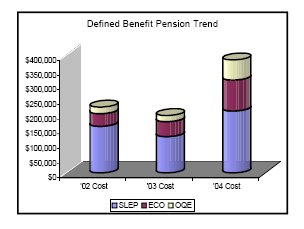
Woodford County Pension Costs

What does this picture tell us?


Well, first off a little clarification on data. The information comes from the recently released annual financial audit.

SLEP = Sheriff's Law Enforcement Personnel
ECO = Elected County Officials
OQE = (all) Other Qualified Employees

Now, here are the compounded average percent increases for these classifications:

SLEP +34%
ECO +39%
OQE +40%

It doesn't take a rocket scientist to see there is potentially an elephant in the budgetary closet here.

We're not sure what or where the '05 cost data is; still hunting.

2007 State of Illinois Budget Summary


. . . and the State of Illinois is . . . tenuous at best
. . . Here's a "budget" summary:


Overview

  • General Funds spending of $25.8 billion is up $1.4 billion or about 6%;
  • The four-year total for the Blagojevich administration is $3.5 billion more than when he took office, or $1 billion more than the $2.5 billion increase Illinois saw during George Ryan’s tenure.
  • More than $250 million in spending added to the Governor’s original budget proposal in order to get it passed.

Record-Setting Budget

  • State Government spending at an all-time high;
  • State debt is at an all-time high;
  • Backlog of unpaid bills at an all-time high;
  • Under-funds the worst funded pension system in the nation;
  • Sets the stage for future pension raids;
  • Ignores warnings of Fitch Ratings, making a downgrade almost inevitable;
  • Illinois is 45th in the Nation in Job Growth since Blagojevich took office, trailing all other surrounding states.

Aren’t You Glad You Are Paying?

  • $1 million for Bullying Prevention;
  • $30,000 for an exhibit to honor legislators from Chicago State University;
  • $200,000 to NEIU to conduct a study on the North Atlantic Slave Trade;
  • More than $7 million in lump sums for the Department of Human Services for undisclosed uses;
  • $50,000 for the South Suburban Disproportionate Minority Confinement Foundation;
  • To cover the cost of insurance for the same-sex domestic partners of state employees.

Education Funding

Education gets $438 million increase. (Financed by short-changing the Teachers’ Retirement System by $495 million. Once again teachers are forced to use their own pension system to fund education in Illinois.)

How the education money is allocated:

  • $170 increase in the foundation level to $5,334 at a cost of $239 million
  • $56.7 million increase for Mandated Categoricals (which mainly benefit suburban schools. The $239 million to $56.7 million ratio (less than one to four) is about half the traditional ratio of one to two);
  • $10 million increase for flat per-pupil grants;
  • $45 million for the Governor’s Universal Pre-school initiative;
  • $10 million for class-size reduction grants.

Veterans Scholarships

  • No money added to the budget to pay for the Governor’s Veterans Scholarships which means the schools (and therefore other students) end up footing the bill.

Pension Raid Continues as Planned

  • Budget underfunds worst funded pension systems in the nation by $1.1 billion;
  • Budget does nothing to reverse the expected rating downgrade predicted by Fitch Ratings;
  • Budget does nothing to prevent more post-election raids;
  • Teachers Retirement System shorted by $495 million;
  • State Universities Retirement System shorted by $140 million;
  • Other systems shorted by $498 million;

Chicago Teachers Pensions

  • The final budget adds $10 million for Chicago Teachers Pension
  • Chicago Teachers Pension System gets fully funded ($75.2 million, up $300,000 from last year)
  • Chicago Plan is 80% funded, while TRS is 60% funded.

Now think about your own personal household or small business budget for 2007. Would you ever dream of doing these kinds of things? We think our favorite line item is the $1 million for "bullying prevention".

Friday, May 05, 2006

Illinois Budget Passes; Legislators Raise Own Pay

The Illinois House and Senate did such a great job with the budget that they decided to allow themselves nearly 10% raises.

The increased legislative base pay rises to $63,149, up from $57,619 annually. The governor also gets a raise of nearly $12,000, putting his salary over the $162,000 mark.

This budget "process" was a joke. Now we won't suggest that this "lockout" of the party "out of power" began with the Democrat party. Far from it; it's been going on for decades, but if Republicans ever do take over, you'd better watch out. They will long remember what has happened here and the results will be uglier than ever.

At any rate, we should all push our legislators to reject these raises in the fall "veto" session.

Saturday, April 29, 2006

U.S. Citizens Are Decent And Slow To Anger - But . . .!

We just had the "pleasure" of listening to the crass commercial exploitation of a very emotional issue represented by this pathetic "Spanish" United States of America national anthem- you may hear it while viewing an English translation at NPR's website.

The translation follows below. Read it carefully.

This is terrorism pure and simple, and self-respecting, law-abiding immigrants in the U.S. should be outraged. The general media has portrayed this as simply a Spanish "version" of OUR national anthem. The reality is something different. It has been rewritten.

These lyrics are a declaration of war on the United States. With no changes to the English translation, it could have been written by the old Soviets, the modern North Koreans, the Iranian President, Radical Islamicists- ala Al Qaeda- , Chavez in Venezuela, or Castro in Cuba; the list is long and varied, but the resentment, hatred, lust, jealousy, and self-pity remains the same.

Our citizenry is slow to anger, and generally patient and kind - but beware - two can play at these games. We can't help the past. We've made mistakes. We've made some sacrifices. We won't, however, let demagogues define our future.

Here's the translation:

" By the light of the dawn, do you see arising,


what we proudly hailed at twilight's last fall?

Its stars, its stripes

yesterday streamed

above fierce combat

a gleaming emblem of victory

and the struggle toward liberty.

Throughout the night, they proclaimed:

"We will defend it!"

(Chant:

It’s time to make a difference the kids, men and the women/Let’s stand for our beliefs, let’s stand for our vision/What about the children los ninos como

These kids have no parents, cause all of these mean laws.
See this can’t happen, not only about the Latins.

Asians, blacks and whites and all they do is adding
more and more, let’s not start a war

with all these hard workers,
they can’t help where they were born.)


Tell me! Does its starry beauty still wave

above the land of the free,

the sacred flag?

Its stars, its stripes,

liberty, we are the same.

We are brothers in our anthem.

In fierce combat, a gleaming emblem of victory

and the struggle toward liberty.

My people fight on.

The time has come to break the chains.

Throughout the night they proclaimed, "We will defend it!"

Tell me! Does its starry beauty still wave

above the land of the free,

the sacred flag? "


Patriotism for one's adopted home or "reconquista" jihad?

God bless all citizens of the United States of America and their guests.

Letters From: Pekin, Illinois

Folks, there is a teacher lobby group called “A+ Illinois” going around the state asking school boards and other elected and private bodies to support a resolution, demanding lawmakers provide a different method of funding education.

Typically, they are using the same old tired story of how this is needed for fairness to students, to hide the real deal, more money for the system to abuse. The new method of funding is a large hike in income and sales taxes! The new funding method DOES NOT lower property taxes!

Below are state figures for the past fifteen years that show the increases that involve education. It is CLEAR, money is NOT the problem. The problem is the “lack” of accountability for those spending the ever growing “Billions” they do get. This history proves more tax monies will not help students, but only the bureaucracy who uses students for camouflage!


(15 Year Consumer Price Index = 39.2%)

Illinois Education "State Report Card" Information 1990 - 2005 :

Total Education Dollars (Billion) 2005 : $6,966,200,000 - $3,487,500,000 (1990) = $3,478,700,000 (99.7%) 15 Year Increase

General State Aid Dollars (Billion) 2005 : $3,712,331,000 - $2,077,733,000 (1990) = $1,634,598,000 (78.7%) 15 Year Increase

Operating Dollars Per Student 2005 : $8,786 - $4,519 (1990) = $4,267 (94.4%) 15 Year Increase

Student Enrollment 2005 : 2,062,912 - 1,766,186 (1990) = 296,726 (16.8%) 15 Year Increase

Teachers 2005: 128,079 - 101,732 (1990) = 26,347 (25.9%) 15 Year Increase

Administrators 2005 : 9,847 - 7,110 (1990) = 2,737 (38.5%) 15 Year Increase

Avg. Administration Salary 2005: $97,051 - $52,564 (1990) = $44,487 (84.6%) 15 Year Increase

Avg. Teacher Salary 2005 : $55,558 - $32,925 (1990) = $22,633 (68.7%) 15 Year Increase

Percent Of Students "NOT" Meeting Standards In Reading 2005 : 47.5% - 25% (1992) = 15.5% A 13 Year "Failure Increase" !

Percent Of Students "NOT" Meeting Standards In Math 2005 : 47.2% - 34% (1992) = 13.2% A 13 Year "Failure Increase" !

Percent Of Students Graduating 2005 : 87.4% - 80.8% (1992) = 6.6% A 13 Year Increase "Inspite Of The Failure Increases" !


Sincerely,

Jim Mangan, Pekin, Illinois

What Do You Pay In Taxes?


Quick, how much total do you pay in taxes? Perhaps the greatest innovation of bureacrats in the 20th century was the tax load shell game - the clever balkanization of the tax load that makes it nearly impossible for the average person to truly know how much they pay in taxes to the government.

Start with income taxes. April 15 is long gone for this year, but even so, how many people know how much they paid in income taxes last year? For many people, this is the single largest expense they have, but the total amount is disguised by the fact that most income taxes are taken out as direct payroll deduction. Governent employees everywhere in the US should get up in the morning and give thanks for direct payroll deduction -- without it, if every American had to write a single check once a year for the sum total of their annual income taxes, there would have long since been a revolution.

OK, so you don't know how much you paid in federal, state and local income taxes. But in addition to that, how much did you pay in social security and medicare (typically about 8% of salary)? Property taxes (typically 1-2% of your home value)? How about sales taxes (typically 6-9% of your purchases)? What about vehicle licensing fees and special taxes on hotels and airfare and rent carsand fuel? If you add all these up, the average American pays about 30% of his/her salary in taxes. The Tax Foundation has a great chart summarizing this shell game, with relative burdens expressed as days of work each year required to pay the tax. Note that on average, your federal income tax is only 1/3 of the total of what you are paying:

So those are the direct ones, but how much are you also paying in higher prices due to government import duties? What about the 8% FICA and medicare that employers pay on your behalf - how much higher might your salary be and how much lower the cost of the products you buy if they did not have to pay these? What about corporate taxes - you may not pay them directly, but they certainly get passed on to you in the form of higher prices and lower dividends on your 401k.

We won't even get into the confiscatory nature of "Death", "Property", and "Capital Gains" taxes. While certainly less hidden, they are perhaps the most insidious, since they are a tax savings and not income or spending.

- - - the Coyote

Friday, April 28, 2006

Woodford White Hats To The Rescue!


This from the PJS's editorial page - their "Thumbs Up" thing:

Friday, April 28, 2006

To Woodford County officials for agreeing to help Tazewell County get its tax bills in order. Under the agreement, Woodford Supervisor of Assessments Laurie Epkins will train new Tazewell employees in processing tax bills. Tazewell tax bills may be as much as two months late this year, in part because there's been so much turnover in the assessment office there. The delayed tax bills cost every Tazewell government money, because they either have to borrow in the interim or fail to earn interest. Counties must get bills out on time. This type of intergovernmental cooperation ought to help. There should be more of it.


Last we knew from the Journal Star's Award Winning Editorial Board [nod to PeoriaPundit], we were the backward hicks of the Tri-County area, capable only of bickering amongst ourselves. Glad we could help out, and a tip o' the hat to our Ms. Epkins and the PJS.

Would A Tax Extension Limitation Law for Woodford County make a difference?

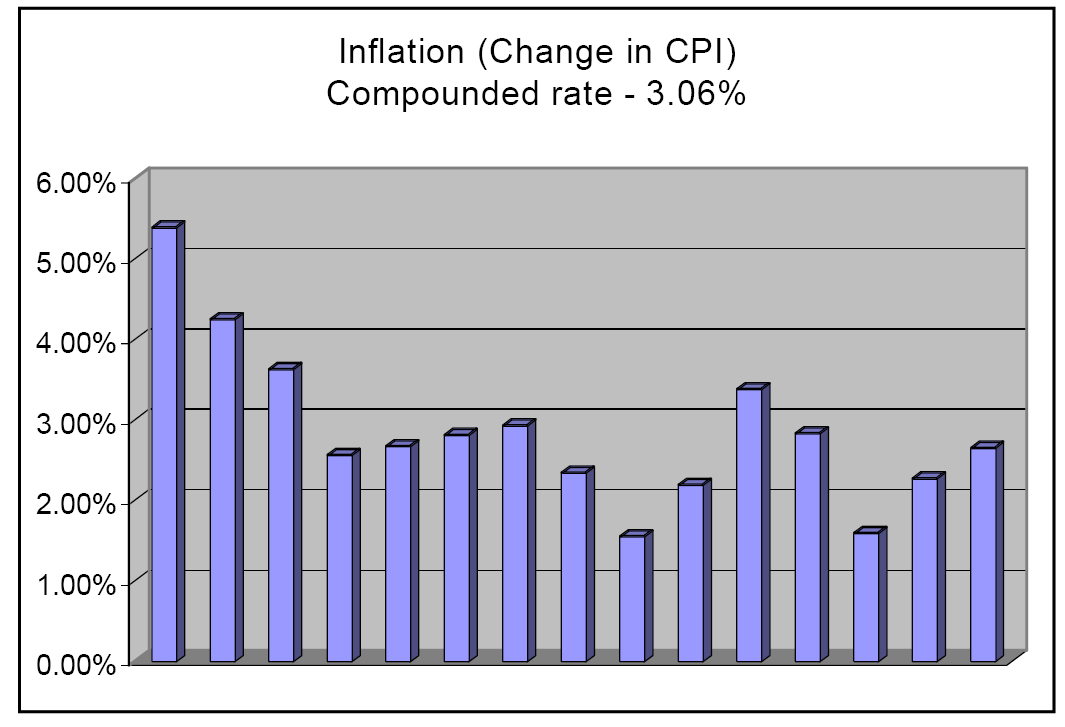
Here is the change in the Consumer Price Index (inflation), year-to-year from 1990-2004.


Now here's the change in Woodford County's EAV (property tax) for those same years.

It's a little hard to read, but notice that the compound annual growth rate is 6.9% while inflation based on the CPI index was just under 3.1%.

Theoretically, the Property Tax Extension Liability Law (PTELL), had it been available and in effect for these years would have bridged the gap between those numbers somewhat.

Wednesday, April 26, 2006

County Gas Tax?

The Peoria Journal Star today has an article speaking to the inclination of some Woodford County Board members to do something with the 1% "Public Safety" sales tax.

We believe there is an embarassment of riches there.

Specifically a trial balloon seems to have gone up from the Board regarding eliminating the County sales tax on fuel purchases at retail. We don't think the short term savings (one or two cents per gallon) justifies such a knee-jerk reaction.


We do, however, find a plan to retire early the bonds which funded the new "Public Safety" complex intriguing.

We've got the tax. We're living with it. Accelerate the repayment of the debt, to the extent the agreement allows, plan for a lean "Public Safety" budget, and ultimately reduce the cost to property tax payers.

Woodford County's future should not include a business unfriendly permanent 1% "Public Safety" sales tax, nor a balancing of the "public safety" budget on the backs of property owners. There must be a middle ground to plow.

Please review this previous post for County revenues.

Tuesday, April 25, 2006

Letters From: FirstClassEducation.com

In Response To Our Recent "School District Spending" Piece:

Patrick M. Byrne
President and Chairman
Overstock.com, Inc.


America’s Classrooms, Teachers & Students Come First
with the 65% Solution

By Dr. Patrick Byrne

Ben Franklin famously said, “A penny saved is a penny earned.” For K-12 education funding, a few pennies saved could mean literally billions of dollars earned for America’s classrooms. That’s the driving force behind First Class Education, a thriving national movement to enact the 65% Solution.

It’s a simple idea. If we can get the business side of education to adopt better business practices, we would have more money for the education side of education. Business schools throughout America teach management techniques called “best practices” and “benchmarking” – determine what the most efficient companies in a given field are doing and apply similar goals for your firm. In the business of K-12 public school education, First Class Education proposes the benchmark of placing 65% of operational budgets in the classroom.

According to the National Center for Education Statistics (NCES), just four years ago seven states across America -- from Utah to Maine, Tennessee to New York -- placed at least 65% of their operational budgets in the classroom. Now only two states do. Four years ago fourteen states placed less than 60% of their budgets in the classroom. Now twenty states aren’t even getting 60% to their classrooms. The NCES has reported dramatic recent increases in K-12 education funding – four times the rate of inflation – while for four straight years the percentage of dollars reaching America’s classrooms has declined. Just 61.3% is now reaching our classrooms as a national average. We can and must do better.

If we were to increase that average to 65%, America’s classrooms would have an additional $14 billion a year without a tax increase. Just 3.7 cents more per dollar to our classrooms would be enough to buy a new computer for every student in America or hire 300,000 additional teachers with a starting salary of $40,000, or a near doubling of classroom supplies.. Small change can equal a big change.

To see what the 65% Solution would mean for your state visit: www.firstclasseducation.org.

Plenty of possibilities exist to save money if school districts had an incentive to be innovative. In Nevada, the Clark County school district recently cut their electric bills with the incentive of giving 10% of the savings back to school principals for their school’s use. The savings: more than $9 million by just turning the computers and lights off at night and stopping the fiddling with the thermostats. In Oregon, the Hillsboro school district will save close to $2 million over the next three years by its recent competitive-bidding of maintenance services. In these examples, “millions saved are millions earned.”

And plenty examples of largess exist in many, if not most school districts. Florida’s Miami-Dade school district has over 240 employees making more than $100,000 a year. Not one is a teacher. Arizona’s Deer Valley school district has 101 school buses, but also 167 cars. In Minnesota a district superintendent recently resigned mid-contract and received $440,000 in severance in addition to his lifetime pension and health insurance.

Nearly every teacher can easily identify waste outside the classroom while they are spending money out of their own limited pockets for basic classroom supplies.

As sound as placing more of our education money in the classroom is for teachers and taxpayers, it’s equally important for students. Rank all 50 states by standardized test scores and you’ll find the top five states place the highest percentage in the classroom – averaging 64.12%. The bottom five states for test scores place the lowest percentage in the classroom – averaging 59.46%. Research by Colorado’s Independence Institute shows the percentage of dollars reaching the classroom had five times greater correlation with increased test scores than simply spending more money.

Thankfully, change is coming. First Class Education was founded less than a year ago, but already Louisiana and Kansas have adopted 65% proposals. Texas Governor Rick Perry enacted the 65% Solution by executive order. Georgia Governor Sonny Perdue will sign 65% Solution legislation into law this week. Supporters in Colorado this week submitted over 100,000 signatures to place the issue before voters this November. Missouri Governor Matt Blunt and Florida Governor Jen Bush are supporting legislative efforts to refer the 65% Solution to their November ballots. Citizen initiative drives are underway in Arizona, Ohio, Oregon and Washington. And Minnesota Governor Tim Pawlenty is pushing a 70% in the classroom requirement for his state.

Let’s support our teachers, benefit our students and be responsible to our taxpayers by ensuring that at least 65% of our education tax dollars reach the place that makes the difference – America’s classrooms.

Dr. Patrick Byrne is the Founder and President of Overstock.com and the National Advisory Chairman of First Class Education.

IMRF, SLEP, ECO, AOQE, and other sundry alphabet soup ingredients in County Pension Outlays


From the Woodford County 11-30-2005 financial audit:


IMRF
(Illinois Municipal Retirement Fund) contributions [by State mandate]:

SLEP (Sheriff's Law Enforcement Personnel - 6.5%
ECO (Elected County Officials) - 7.5%
AOQE (All Other Qualified Employees - 4.5%

County contribution rate for calendar 2004:

SLEP - 15.44% of payroll - $ 210,517 total
ECO - 56.55% of payroll - $ 105,063 total ( 5 persons, if we're correct)
AOQE - 2.90% of payroll - $ 68,957 total

Now, if we're not mistaken, Woodford County got hoodwinked by the State of Illinois by the ECO thing in 1997, and opted out in 2000. The result - we're stuck with over $100,000 per year in pension funding for a handful of County employees, while the remainder have some what less than $280,000 per year contributed on their behalf - we'd say that goes for in excess of 100 employees, as a guestimate.

We don't have an answer . . . we can only ruminate on the mistakes. The elephant is stomping in the closet.

Topinka Advocates Sales Tax Cap On Gas


We're pretty sure that the total excise tax, State and Federal, is 58 cents per gallon in Illinois. If we're off a few cents, it's only because on the incredible obfuscation on this issue. The dirty little secret over the past year or so is that sales taxes on the increased prices at the pump have been a huge windfall for State, County, and Municipal governments.

Yesterday, Judy Barr Topinka said she'd like to "freeze" State sales tax when the pump price is $2.50 per gallon or higher. The tax would be collected on $2.50 even if the actual price was $4.00

Aside from the retailers' nightmare of tracking a change like this, it sounds like a good start to us. Now to get the feds on board. If the sales and excise tax on fuel isn't going to be dedicated exclusively to road building and maintenance, then we've prefer getting rid of them entirely. They shouldn't be used as windfalls for the "general funds". How's that for a "windfall profits tax"?

Monday, April 24, 2006

Timberline Camp Ground and Arsenic?


The Peoria Journal Star today reports that Timberline Mobile Home Park has been cited by the Illinois EPA for twice the acceptable level of arsenic in its well water. Unfortunately, the yard stick was moved the first of the year. The "acceptable" level went from 50 parts per billion to 10 ppb.

Arsenic is a sometimes naturally occurring component of some well water. Last year they were well (no pun intended) within the limits - this year they face fines or worse. Sigh . . .

The PJS also seems miffed that Timberline and the other development mentioned are owned by "out-of-towners". I don't know what the population of Timberline is, but I doubt if there are a whole bunch of investors located there - maybe they mean Goodfield - or Peoria. I don't think Cat is owned by "townies". I'm not sure about the PJS. That angle seems a quasi-populist spin which is specious to its core. Let's just look at the facts and not whether the landlord lives on site.