Wednesday, November 15, 2006

ComEd and Ameren monies plugged in


From the aforementioned Board of Elections site, these are 2006 to date contributions $10,000 and above:


Ameren PO Box 66892
St Louis, MO 63166
$20,000.00
10/12/2006
Individual Contribution
The Illinois Chamber Pac


Ameren P.O. Box 66892
Saint Louis, MO 63166
$10,000.00
5/2/2006
Individual Contribution
Friends of Blagojevich


Ameren P.O. Box 66892
Saint Louis, MO 63166
$15,000.00
10/30/2006
Individual Contribution
Friends of Blagojevich


Ameren PO Box 66892
St. Louis, MO 63166
$10,000.00
9/30/2006
Individual Contribution
Democratic Party of Illinois


Ameren PO Box 66892
St. Louis, MO 63166
$15,000.00
11/2/2006
Individual Contribution
Democratic Party of Illinois


Ameren 607 E. Adams Street
Springfield, IL 62739
$10,000.00
3/1/2006
Individual Contribution
Republican State Senate Campaign


Ameren 607 E. Adams Street
Springfield, IL 62739
$10,000.00
9/22/2006
Individual Contribution
Republican State Senate Campaign


Ameren P.O. Box 66892
St. Louis, MO 63166
$10,000.00
9/19/2006
Individual Contribution
Citizens to Elect Tom Cross


Ameren P.O. Box 66892
St. Louis, MO 63166
$10,000.00
2/27/2006
Individual Contribution
Citizens to Elect Tom Cross


Ameren P.O. Box 66892
St. Louis, MO 63166
$15,000.00
10/11/2006
Individual Contribution
Citizens for Emil Jones


Ameren P.O. Box 66892
St. Louis, MO 63166
$10,000.00
10/23/2006
Individual Contribution
Citizens for Emil Jones


Ameren 607 E. Adams St.
Mail Code C100
Springfield, IL 62739
$10,000.00
3/6/2006
Transfer In
Citizens for Frank Watson


Ameren P.O. Box 66892
St. Louis, MO 63166
$10,000.00
3/6/2006
Individual Contribution
House Republican Organization


Ameren PO Box 66892
St. Louis, MO 63166
$10,000.00
3/8/2006
Individual Contribution
Friends of Michael J Madigan


Ameren 607 East Adams
Springfield, IL 62739
$25,000.00
3/1/2006
Individual Contribution
Ameren IL PAC


Ameren PO Box 66892
St. Louis, MO 63166
$10,000.00
9/27/2006
Individual Contribution
Friends of Michael J Madigan


Ameren 607 E. Adams St.
Springfield, IL 62739
$15,000.00
3/7/2006
Individual Contribution
Illinois Senate Democratic Fund


Ameren 607 E. Adams St.
Springfield, IL 62739
$10,000.00
11/3/2006
Individual Contribution
Illinois Senate Democratic Fund


ComEd PAC 1 Financial Place 33rd FL.
Chicago, IL 60605
$14,000.00
9/18/2006
Transfer In
Citizens for Emil Jones


ComEdPAC 1 Financial Place 33rd FL
Chicago, IL 60605
$10,000.00
10/3/2006
Transfer In
Manufacturers PAC (MPAC)


ComEdPAC 1 Financial Place
33rd Floor
Chicago, IL 60605
$10,000.00
9/22/2006
Transfer In
Illinois Merchants PAC Team

ComEd looks cheap compared to Ameren, huh?

Today in the Illinois Senate we saw what PAC money did for the mimimum wage hike. We'll soon see how the Electic Rates come out.

S(c)hocked


While trolling through the campaign contributions at the Illinois State Board of Elections Campaign Disclosure site, we were a little surprised to find this last minute contribution to Citizens for Schock:

Khazzam, Alexis N

$16,000.00
11/2/2006


We were, frankly, also a little surprised at this one:

Illinois PAC for Education (IPACE)

$10,000.00
11/1/2006

seeing as how they usually fund Dems a little more heavily. A little further investigation reveals that Big Education did fund Republican candidates a little heavier this time around, but only if they were incumbents. Next to nothing went to Republican challengers. Interesting.

We will be posting some more numbers (what we were originally searching for) in the near future.

Peoria Chronicle Skewers PJS


Here's todays impalement of the Peoria Journal Star on its recent stand regarding the bonds for District 150:

Journal Star could use some remedial civics classes itself

Speaking of the Journal Star’s editorial yesterday, they sum up their case for PBC funding with this condescending paragraph:

But again, the primary criticism comes from those who’ve never quite come to grips with the fact that they live in a republic, not a direct democracy. Should District 150 regain its PBC connection, perhaps it should spend those funds constructing a building in which they teach civics, the lessons of which seem lost on a certain segment of the population.

Translation: if you’re against the school being able to get funding through the Public Building Commission (PBC), then you’re an ignorant boob in need of remedial education.

Maybe the editors of the Journal Star should attend those civics lessons instead. They can start by studying the words of Thomas Jefferson in the Declaration of Independence, where he says that governments “deriv[e] their just powers from the consent of the governed.” Thus, if the people don’t want the school board to have the power to spend tax money on new schools without a binding referendum, that is perfectly within the rights of the citizens of a republic.

Indeed, one needn’t throw out the school code or the Constitution, nor do they need to resort to direct democracy, in order to place reasonable limits on their representatives in our current form of government. In the case of the PBC, these limits already exist, and those who oppose PBC funding are not arguing for new legislation, but the status quo.

And since when is it the job of our legislators to represent other municipal corporations? Are Schock and Shadid representatives of the school board or the people? In this case, they’re acting as representatives of the school board, since the people clearly don’t consent to additional bonding authority being given.

And since the Journal Star thinks PBC funding should be available to all, why are they in favor of SB2477 which would only grant this bonding authority (a) for 5 years, and (b) only for Peoria Public School District 150? The Journal Star should be fundamentally opposed to this abridgment of our republic and advocate instead a bill that would completely repeal the 1993 law that stripped all school boards from using the PBC. Of course, such a bill would never pass the legislature, because it’s easier for representatives from elsewhere in Illinois to pass laws that don’t affect their constituents.

Here’s another civics lesson for the Journal Star: citizens of Illinois have the right under Illinois’ constitution “to make known their opinions to their representatives and to apply for redress of grievances.” In other words, voting our representatives out of office is not our only avenue for participation.

What Education means when they say "community involvement"


This article, and a response, have some interesting insights into how our school districts stack the deck when it comes to "citizen advisory committees":

Daily Pantagraph: Olympia wants to spend money on new grade school

STANFORD -- Olympia school district residents want to spend referendum
money on a new Olympia North Elementary School and upgrading electrical
and security systems at all the schools.

That was the consensus of five groups of residents reporting this week to the district’s Citizens Facilities Planning Committee.

That was the consensus of five groups of residents reporting this week to the district’s Citizens Facilities Planning Committee . . .

The planning committee was organized to collect public opinion on how
to spend money from the April 2007 referendum. The five groups that
report to committee were formed as part of a series of public meetings
last month at Olympia’s five schools . . .

The April 2007 referendum will have two questions asking for a total
tax rate increase of $1 per $100 equalized assessed valuation . . .

One referendum will ask voters to let the district issue $12.5 million in
bonds for construction. That would carry a rate increase of 50 cents
per $100 EAV.

The other referendum would seek an increase of 50
cents per $100 EAV for the education fund, which pays for most
operating expenses. The education rate would increase from $2.40 per
$100 EAV to $2.90 per $100 EAV . . .

“They [the committees] have now been able to see the common needs throughout the district and definitely have developed a district view and perspective,” [District Superintendent Hahn] said. “(District architect Sam) Johnson (of BLDD Architects) told them to put their board member hat on, and they did just that.”

Too bad the architect didn't tell them to put on their "tax payer hat" instead of their "Board hat".

In response to that Pantagraph article, the following was posted anonymously on their website in the way of a reply:

"Just so you all know. I was part of one of the "Community Groups". Yeah, we
were told to put our "board member hats" on, BUT we were also given constraints surrounding how we spent our money. The "BOARD" had already decided that we would build a new school for North. The only thing we got to "recommend" was how big the replacement school would be and how we should spend the rest of the $$ from the bond. We had to make sure we were "fair" with how we split the rest out in order to try and sell the idea to the rest of the district. What a total joke!"

The Illinois Loop has an excellent piece on School Committees and the administration strategies involved. It's nine pages for those of you interested in the whole thing. Here are some excerpts:

At best, many "consensus" committees whittle away personal goals in favor of lukewarm
conclusions that make no one happy. Emerson said, "A foolish consistency is the hobgoblin of
little minds."

These techniques (sometimes labeled as "Delphi" methods), were developed early in the 20th
century, where they were heavily used by trade unionists and by progressive social organizers
such as Saul Alinsky. These techniques are heavily in use today by corporations, churches,
human resource organizations, trade organizations and social groups in forming a "consensus"
supporting pre-constructed goals. It use of the "committee" along these lines has been a powerful tool used by schools in building support for changes in school policies or curriculum.

The key to such committees using these techniques is that the desired outcome is planned in
advance. The purpose of the committee is not to design or plan or come up with a new course of
action. Rather, the purpose is to "achieve consensus" on a desired course of action that is already known (by the organizers).

Many people are well-familiar with these techniques from their use in business, though they don't usually recognize them as such unless it is pointed out. Corporations might use such committees to enlist employee support for a new program or reorganization.
The same techniques are also often used by trade organizations and professional associations to
solidify support for the most commonly-held agenda items, and to winnow out more marginal
concerns.

A key element of these committees is the "small workgroup". Members of the whole committee
are assigned into smaller groups to "work" on some subset of the "task" assigned. This has a
number of effects.

1. First and foremost, it breaks up cohorts so that like-minded people each find themselves as
the odd man out in their small workgroups.
One strategy that is extremely common in school presentations and committee meetings is
"random assignment": As participants enter the meeting room, they are handed a card with
a number, which is the number of the groups that have been assigned to. This technique is
extremely effective in breaking up sets of people that arrive together. If three people feel
strongly about an issue and arrange to go to the meeting together, they could exert
influence if they were allowed to be in the same group. This technique prevents that.

2. Beyond that, these small workgroups keep people from challenging the big picture, from
questioning the limitations of overall structure or the material provided, and from limiting
concerns to one's own group and not disturbing or questioning the progress of another
workgroup.

In schools, these committees are used to get teachers, parents and others to "buy into" a proposed initiative. There is nothing resembling Robert's Rules of Order or any informal procedure even vaguely related. There is no open debate, no discussion of what the goals of the committee should be, and certainly no voting. It goes without saying that there is no process to select a leader for the group -- the leader is already a given, typically a school administrator who has been trained in the techniques of being a group "facilitator".


Any of this sounding familiar, folks?

For another take on this problem, see this post from C.J. Summers:

Arnstein’s Ladder

Tuesday, November 14, 2006

Tazwell County Spending To Rise 1%


According to the Peoria Journal Star:
The Tazewell County Board is set to approve a $49.5 million fiscal year
2007 spending plan that includes money for additional correctional
officers at the Tazewell County Jail and funding for improvements
within the Supervisor of Assessments Office.
They go on to say later in the article that:
Overall, the budget is up about $500,000 from what was budgeted in fiscal 2006.
Sixty percent of the budget for next year will go for salaries and benefits.


Monday, November 13, 2006

Illinois HB 750 Tax Swipe . . . erhh . . . Swap.


The Illinois Democrat election wins and domination in Springfield seem to presuppose the passage of Illinois HB 750. The teachers unions have made it quite clear what they expect for their massive contributions to candidates.

The HB 750 "tax swap" to reform education funding has been in the works for nearly two years. The idea is to reduce dependence on property taxes for education. That sounds like a reasonable plan until you examine what they really mean by this. Hint: all education money will go first to Springfield and then to the schools; no more local referendums - no more local control, and no guarantee that local property taxes won't go right back up to previous levels.

This is simply a tax increase, and a move to put education funding into Springfield where it can be controlled by Big Education and the unions.

Income taxes are to go up by 2% and business income taxes by 4%. There will be a 6% sales tax on "services". There is to be a tax abatement to reduce the portion of property taxes going for education, subject, of course to interpretation in Springfield. However, there is really no guarantee that this money will find it's way back to property tax payers and indeed, without being cynical, we wouldn't be surprised to hear an announcement down the road that this money is needed to make up short falls in the teachers' pension funding.

The estimated increase in taxes will be $7.2 billion; the estimated property tax reduction will be $2.5 billion; as if we don't have enough problems with the business climate and job creation here in Illinois!

HB 750 sounds good if you listen to education, Springfield, the media, and the unions; not so hot if you examine the real bill. Unfortunately, there is no real clout lined up to oppose this assault on tax payers.

The Extensions Are Coming. The Extensions Are Coming!


Over the next few weeks your friendly local neighborhood Taxing Authorities will be releasing their requested property tax extensions. We think we can safely predict that none of them will be less than last year although some may be claiming they are "reducing taxes" because they are temporarily lowering the tax rate.

In addition, the "stealth tax" - the silent tax hikes due to rising appraisals - will continue to rise. This is due to taxing districts spending the increased property taxes from higher appraisals but not lowering the tax rates.

There are three factors to keep in mind when reviewing these extensions. The first is the tax rate, which Woodford County for example, plans to lower. The second is the EAV (equalized assessed valuation). That's the sum of all the assessed valuation property in the taxing area. The last is the levy, which is what the taxing district says it needs to operate, which Woodford County for example, will be up.

To avoid the confusion, which benefits the taxing authorities because it decreases criticism from the public, the easiest thing for a voter to do is focus on spending by the taxing authorities. Is it up? How much? Is that reasonable? Where is this "new money" coming from?

The real issue for the County, School Districts, Library Districts, Fire Districts, Community Colleges (especially ICC) is SPENDING, and how much is the budget increase? The rest can be, and usually is, smoke and mirrors.

Still No Woodford County Web Site!


It has now been eight months since the Peoria Journal Star headline screamed, "Woodford County To Develop Web Site"!

Chairman Whitaker said, "Ten years ago, I would have scratched my head and said, 'Is this something we really need?' Today, we really need it."

The newly hired Administrator Greg Jackson said, "There are efficiencies that can be gained from e-government technologies," Jackson said. "It also shows the public that we are an open government and allows (the general public) to come online and see what we can do."

Of course this was during the primary election when certain candidates were vowing to "drag Woodford County, kicking and screaming if necessary, into the 21st century". We believed then and we believe now that this publicized vapor-ware of a web site was a stunt.

The County Board granted over $6,000 to Minonk to develop a web site. It's granted money to El Paso. Presumably the need is perceived for a county website:

Jackson said his efforts, thus far, have been well-received, with all the county department heads and elected officials supportive of the Web idea. "They are as excited about this as I am," he said.

Meanwhile, citizens of Woodford County must drive by the County Boardroom in order to see meeting agendas and minutes. There is no easy way to email Board Members. There is no easy way for voters to monitor budgets or committee meetings. The majority of Illinois counties had up to the minute elections results last week. Not Woodford. Many Illinois Counties allow for fee paying online. Not Woodford County.

Perhaps the leadership has been too busy scheduling special meetings to discuss the sanctioning of other Board members to worry about tax payer participation in local government.

This is an issue of transparency in government. Woodford should open up to scrutiny by the taxpayers.

Eight months and counting since the promises. We'll keep you posted.

Saturday, November 11, 2006

Peoria Pundit Calls 150 on Bonds


Peoria Pundit hits this one out of the park in his blog:

Retiring State Sen. George Shadid is torn over whether or not to try to override Gov. Blagojevich’s veto of legislation that would let the Public Building Commission raise taxes on behalf of Peoria School District 150 without benefit of a referendum.

“I don’t think we’re able to satisfy the governor because the governor has a very narrow definition, or a very conservative definition, of what a tax increase is,” said district treasurer Guy Cahill.

The school district’s position is that the legislation would not lead to a tax increase.

Rather, the district would replace old bonds with new bonds. As a result, the tax rate would hold steady, but people would pay that rate for a longer period of time. If the school district does not issue new bonds, the tax rate gradually would decrease starting in 2007.

Shadid said he is trying to get a consensus from community leaders about whether to attempt the veto override.

The senator says he normally would be completely in favor of helping out District 150, but too many people have told him they they just flat out do not trust the people in charge of the district these days.

My two cents: I am one of those people who just doesn’t trust District 150 these days. But I would be opposed regardless.

Let’s dispense with the “it’s not a tax increase because your tax bill is the same argument.”

Lets say you took out a car loan. The last payment was made in October and you owe no more money, your obligation is over. But the bank sends you a bill anyway for the exact same amount in November. You call them to ask what’s going on and they say you have no right to complain because it’s the exact same bill you got last month and it’s no increase in your financial obligation to the bank.

That’s exactly that District 150 wants to do. Folks, the district is retiring one debt and that means taxpayers’ obligation is over. State law prevents them from going into debt again without a voter referendum. Because trust for District 150 is at an all-time low, there is no way voters will approve. So, they want a state law to allow the city’s public building commission — the PBA — to have the power to issue bonds to help pay for District 150’s planned building spree without benefit of a referendum. And the backers of this plan are walking around telling folks it’s not a tax increase because the tax bill is going to be the same .. just like my hypothetical bank.

It’s a tax increase folks. Cahill knows it. He’s a money guy. He knows he’s feeding taxpayers a smooth line.

Don’t fall for this line.


State universities created for sons of toil


We were particularly struck by the following editorial letter to the Indianapolis Star dated Friday, November 10, 2006. While clearly discussing Purdue in particular, we think Mr. Morills comments are worth remembering as our state universities and community colleges race ahead further and further from their roots. As always, the emphases are our own:

I was disappointed in my alma mater, Purdue, and Indiana University, after reading The Star article ("In-state students increasingly on the outs," Oct. 30.) It felt like I just got kicked out of the house so my dad can give my room to a stranger from Illinois.


The state university's first priority is with the natives because we pay for them through our taxes. Purdue is certainly to be beholden to sons of the state because it is a land-grant college whose chief congressional architect, Rep. Justin Smith Morrill, said in 1862: "This bill proposes to establish at least one college in every state upon a sure and perpetual foundation, accessible to all, but especially to the sons of toil."

Admission standards are expected and understood. However, these state universities were not designed for the intelligentsia and their own elitist ends by recruiting "talent" and exclusive bumper-sticker honor society students. They were designed for us -- the sons of toil.

Greg Rosen
Indianapolis

Thursday, November 09, 2006

ANOTHER Tax District in Woodford County?


We can see right now that a referendum is coming on a "Eureka Park District" being created and funded from new property taxes on owners in what is roughly the CUSD #140 area.

We need another taxing authority in Woodford County like we need another piece of SPAM e-mail.

There are already too many taxing districts (authorities) in Woodford County - 140 at last count. That's one unique taxing body for every 265 residents!

We can see why the City of Eureka and District #140 would be on board for this train wreck, the former eager to shift costs out of budget and the latter figuring it will be good for the athletic program, and better to keep those costs elsewhere on the tax bills. What is also clear is that the main thrust is a land-grab by the Eureka Youth Recreation Association and the local Junior Football League.

We (and we hope you) will keep a close eye on this one.

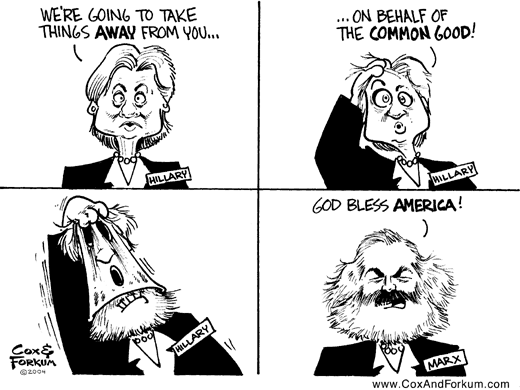
For The "Common Good"


We suspect that you will be hearing a great deal about "The Common Good" over the next months and years from the "new" congressional leaders.

(As a side note, this "national 'vote for change' " translated into a massive reelection of incumbents - as usual. This year's rate is around 96%.)

Hold on to your wallets. This "Common Good" work is code for transferring money to the special interest groups which elect the majority.

It will be a "difficult slog", but if you, unlike the majority of Americans, can hold onto an integrated philosophy of what is best for you, your family, and ALL citizens, you will prevail.

Unfortunately, most voters don't have a consistent, coherent political philosophy. They will pick and choose issues which benefit them and they really don't care about society as a whole. It's a contradictory patchwork; and it works for pandering politicians.

Americans seem to also have a taste for telling other what or what not to do. Referrenda on banning smoking, caging pets, extending zoning ordinances, etc. are more popular than ever - as long as it's the OTHER guy paying and getting regulated. Voters at the local level have tasted using government power to force others to their viewpoint and it makes them feel empowered.

Stay the course and do not be seduced. Stay active locally with your county, school board, lobrary board, fire district, etc.

Your taxes on a state and federal basis are going to be increasing more rapidly than ever before. Get prepared for it and work to ensure your local taxes are held in check.

Good luck, we're all counting on you.

Tuesday, November 07, 2006

Election Night Online


Two spots not to miss for you election results junkies:

1. Illinois State Board of Elections

They've promised to have "live" updating numbers beginning when the polls close at 7 PM.

2. CNN.com

Yeah, we know, but coverage can be expected to be extensive and the Web site has been promoting the CNN Pipeline live video-news premium service touting live pundits and reports from election headquarters. You can also create a personalized scorecard to watch individual races.

In addition, they've invited almost two dozen political bloggers to "live-blog" the results from an Internet cafe in Washington, D.C. Some of the blogs will be taken live on the air on the tv side.

Saturday, November 04, 2006

Guest Post: Illinois Pension Nightmare

A "Nightmare" Indeed

from illinoisreview

Yesterday's Tribune headline blared "Illinois' pension nightmare." Here are some excerpts, with thoughts attached.

Illinois, with an estimated $45.8 billion pension shortfall, has among the worst funding records in the country. From Connecticut to Oklahoma, pension obligations are threatening to overwhelm budgets, pinching states' ability to pay for pressing priorities such as education, transportation and health care.

From a political perspective, this offers the best opportunity in a generation to create real political reform. The culture has always been able to digest a little corruption, but the politicians here have a) created a huge patronage army of government workers (yes Virgina, teachers are government workers), and b) showered them with unsustainable benefits, which sadly, are Constitutionally protected once vested.

What few people understand is that there isn't enough future tax revenue to pay off these promises. Taxation will only yield economic decline that destroys the ability to pay the promises. Reform is no longer an "option," it's now a force of nature.

The parsite no longer lives in harmony with it's host.

Then came the 2001 recession and stock market collapse, which reduced pension funds' value and triggered a budget crisis during Gov. George Ryan's administration. At the same time, a costly early-retirement program increased the pension obligations.

The "recession" had barely any impact. Stock values are back above where they were in 2001, and this should be reflected in the article. The fact is that our politicians, bought and paid for by the patronage army they created, showered unsustainable benefits on their funders.

The mediocre Tribune, strategically running this article 1-2 years too late, (but clearly designed to benefit Topinka) is as responsible for the shortfall as any entity in the state. They probably endorsed 80-90% of the politicians that voted for this obscene largess, all while promoting the myth that "more money = better education."

At an HB 750 "Dog and Pony" show, I pointed out to the crowd that IL spending on education increased 153% from 1985 to 2003, while enrollment had only increased 13.1%. The Honorable John Frichey's response was refreshingly honest. He said, "Yeah, but that all went to pensions.

Though not covered in the article, Illinois Review readers should know 2 things about the recent "roll back" in the piggish "Early Retirment Option." First, your legislator's paymasters (teacher's unions, BIg Ed) are busy working to restore the full obscenity through large exceptions. Second, the obscenity of the ERO can and will continue at the local level, provided the district has the money.

Did you ever wonder why so many districts are crying poor? They are loading up for providing locally funded EROs. Go ahead and FOIA your latest teacher's contract. Look at the goodies. If you don't have the time, at least have the decency to vote down all referenda.

But unless it's solved, Msall and others warn, taxpayers will be the losers. The state constitution requires that retirement benefits be paid at the level they were promised. While lawmakers can decide to cut school funding, they can't get out from under the pension obligations.

"Pension funding will trump all other contributions over time," Msall said. "It should be at the front of anybody's mind who cares about education, about transportation, because if you don't get the system fixed you're not going to have any money for those in the future."

Nothing would be more deliciously ironic than watching 'real' education spending being cut to fund the piggishness of the generation that came before it. Whether the vehicle is a
"fake" tax swap, another give away to retired government workers, or an argument over funding an increasingly failing education system, the ground may well shift under Illinois political status quo . . .


Thursday, November 02, 2006

Guest Post: My Libertarian Propositions

A Dialogue With A Liberal
By Arnold Kling, October 13, 2006

"Consider this an invitation. Are these propositions meaningful? Are they helpful? Are they simply wrong? As a liberal, how would you change them or modify the list? As a conservative, how would you draft a similar list for conservatives?"

-- Geoffrey R. Stone, What it Means to be a Liberal


I will take up this invitation University of Chicago law professor Geoffrey Stone, speaking not for conservatism, but for my own brand of libertarianism. First, let me comment on a couple of his propositions.

Stone writes,

Liberals believe individuals should doubt their own truths and consider fairly and open-mindedly the truths of others...Liberals are skeptical of censorship and celebrate free and open debate.

I agree that this is the liberal ideal. In my experience, liberals are not as open-minded as I would like, but open-mindedness is a difficult ideal to uphold. I am pleased to see open-mindedness listed first.

Later, he writes,

Liberals believe government has a fundamental responsibility to help those who are less fortunate. It is liberals who have supported and continue to support government programs to improve health care, education, social security, job training and welfare for the neediest members of society. It is liberals who maintain that a national community is like a family and that government exists in part to "promote the general welfare."

I believe that in reality what has helped the less fortunate is economic growth. Today's elderly are affluent not because of Social Security, but because of all of the wealth created by private sector innovation over their lifetimes. Government involvement in health care and education is an impediment to progress in those fields. Job training and welfare are demonstrable failures. I think that treating a national community like a family is a grave intellectual error. A national unit is an institution that creates a legal framework for a large group of strangers to interact. A family is a small group that interacts on the basis of personal bonds. Strengthening government serves to weaken families and other vital civic institutions. If Professor Stone is truly as open-minded as he says, then he ought to examine what economists have found about the sources of economic growth and the ways that poverty has been alleviated over time.

My Libertarian Propositions

1. Liberty is important for its own sake. People are entitled to make their own choices.

2. There are other values in addition to liberty. However, many noble causes end up infringing on liberty without achieving their desired ends. Government policies should be evaluated on the basis of their consequences, not on the basis of how they make us feel. It may feel good to set a minimum wage, to impose rent control, or to declare a war on drugs, but the evidence is that such policies tend to work to the detriment of their intended beneficiaries.

3. I value relieving the suffering of others. However, compared with liberals, I have considerable humility when it comes to advocating taking other people's money in order to satisfy my urge to alleviate poverty.

4. Corporate power is adequately checked by market forces. Competitors are the main force protecting consumers. Alternative job opportunities are the main force protecting workers. For corporate power to be a threat, it must be allied with government power.

5. We would be better off with much less regulation. I will grant that some forms of deregulation, such as eliminating meat inspection, appear to have risks that outweigh the potential benefits. On the other hand, many forms of deregulation, such as eliminating licensing restrictions for medical practice, have potential benefits that outweigh the risks.

6. Government is just one of many institutions for collective action. There also are trade associations, civic associations, religious groups, charities, and many other organizations that can provide collective goods.

7. Government's unique institutional characteristic is the legal use of coercive force. This creates enormous potential for abuse, and indeed, there are many countries where government abuses its powers constantly, to the severe detriment of the population. The abuses are less evil in the United States, but where liberals look at government expansion and see opportunity, libertarians see threat.

8. Providing for the common defense is a legitimate function of government.

9. There is no such thing as the "international community," only a constantly-changing array of allies and adversaries. The United Nations serves mainly to prop up authoritarian regimes. The European Union is a bureaucratic nightmare. The United States should be proud of our ideal of liberty, especially economic liberty.

10. In a world where small, covert operations (also known as terrorism) are a significant threat, government needs to use the tools of surveillance. However, surveillance power must be subject to checks and balances that are beyond those currently available.

Arnold Kling is author of Learning Economics.

Governments Oppose Things That Work

Courtesy of Coyote, we submit this,
via Neal McCluskey at Cato:

District officials, as well as the president of the teachers union, bristle at assertions by the Charter Schools Association that middle and high school charters are significantly outperforming their district counterparts.

A fairer comparison would be with the district’s magnet schools, which outperform charters, school board member Jon Lauritzen said.

“I think it’s basically unfair to compare an entity that is able to take their entire budget and focus it entirely on their own schools,” he said. “They have some real advantages over our schools in the flexibility of actually providing the type of education that a particular community wants, whereas we are trying to provide a curriculum that works for everyone all across the school district.”

This last paragraph is hilarious on its face. The average parent must wonder what Mr. Lauritzen is doing with the public school funds in contrast to focusing his entire budget at, you know, the schools, like those evil competitors do. And what government official would ever be caught dead providing the type of serves that a particular community actually wants. And this is all in the context that charter schools are, in McCluskey's words, a "pale shade of choice."

So, what does the teachers union and school board members do in the face of competition that they acknowledge works better? Do they demand the same flexibility in spending and rules in their own schools? No! Of course not! They demand that the schools that work better be eliminated:

It’s no wonder that, a few months ago, Mr. Lauritzen proposed a moratorium on charter schools, and that public schooling’s defenders fight even harder against reforms like vouchers and tax credits. After all, who could just sit by and watch parents get schools they want when an old, hopeless system is suffering?

Wednesday, November 01, 2006

Ahh, John Kerry - Ya Gotta Love Him

Senator Kerry stepped in it again and his timing was pretty bad. We think we can accept that he was trying to slam President Bush (although his own university performance was rather lackluster "his own self") and blew the joke. Never the less, it provides an opportunity to examine the myth, promoted by anti-military types, that the poor make up the majority of those that serve.


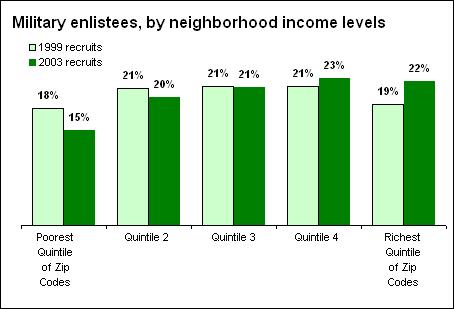
The facts simply don't bear this out:


The military really doesn't ask how much money your parents make when they sign you up. However, they do ask you what zip code you are from, and this analysis seems to belie the assumption, showing the army is actually made up disproportionately of recruits from the richest rather than the poorest zip codes.

Tuesday, October 31, 2006

Halloween Gets The Ax


Halloween gets the ax:


"School crime was dealt a sharp blow in Pittsburgh, Pennsylvania, when Jordan Locke was suspended for bringing an ax to school. In an open letter to area media, Superintendent Joel Carr and school board President Thomas DeBolt wrote, 'As administrators of schools, with the safety of hundreds of children in mind, it is also our job to protect lives, too!'

"The incident was controversial because: 1) Jordan is five years old; 2) his ax was five inches long and made of plastic; and 3) it was part of his Halloween costume. Jordan dressed as a firefighter. He was suspended for violating a district policy that prohibits weapons - real or toy. Firefighters objected to their tool being labeled a weapon, prompting Carr and DeBolt's open letter apologizing for the incident."

Abentee and Early Votes More & More Important


Early voting has grown in the past 15 years, from around 2% of the national electorate participating to about 20% in 2004. Experts predict this year that 19% to 25% of the electorate will vote early at the polls or by mail-in absentee ballots. That compares with about 14% in 2002, the most recent midterm election.

Fueling the trend toward early voting, 30 states now allow unrestricted absentee voting, with 15 , including Illinois, allowing early voting in person at county-clerk offices and polling areas.

These votes, by definition, cannot be included in media "exit polling", so don't listen to the exit polling data which you'll hear throughout election day. They don't mean squat.

If you didn't vote early (and often, as a friend of ours likes to say), go ahead and get to the polls on election day, November 7th, regardless of whether you think your vote will "make a difference" or not.

We know it will.

The True "October Surprise"?

One week from today the votes will be tabulated and all of the guessing will be over!

The Mike Allen report lays out some interesting last minute information:

Top Republican officials believe the GOP will keep both houses of Congress next Tuesday, and they have five good reasons to think so (in addition to Bush's residual popularity in some crucial states and districts:

1) No Republican is being taken by surprise, unlike many Democrats in 1994. Shortly after Bush's reelection, White House and Republican National Committee officials began working to convince House members that the formidable reelection record for incumbents (since 1996, 97.5 percent) was not something they could take for granted. "What we attempted to do last year," said one of these officials, "was to go out of our way to say to people: 'You face a potential of a race. In order to win as an incumbent, you better have a plan,' " including an intensive focus on voter registration, a message plan that would unfold in phases, and a ground organization that was operating in a measurable, quantifiable way. One official involved in the process said Republican officials deliberately "scared" lawmakers, telling them: "You face a very tough road. You better be ready."

2) Absentee ballot requests and returns, closely tracked by the party, are meeting or exceeding past levels for Republicans in key states and districts. Republican officials say White House Deputy Chief of Staff Karl Rove and party operatives are scrutinizing this data with the same intensity that they followed metrics like voter registration earlier in the cycle. For at least 68 races, they have been getting reports once a week on the number of voters registered, phone calls completed and doors knocked on. Now, they're getting a second report on the number of absentee ballots requested, absentee ballots returned and early votes cast. "We can look at that data flow and make an assumption about what's going on and plotting it out," a Republican official said.

3) When the national parties, national campaign committees, state "victory" committee accounts and competitive campaigns are added up, Republicans maintained a substantial financial advantage over Democrats at the last filing period. "We didn't look on it as one pot," said one official involved in the process. "We looked upon it as four pots, with synergy available through all four."

4) Republicans say the district-by-district playing field favors them in several structural ways not reflected in national polls. Here is their thinking, starting with statistics from the President's 2004 race against John F. Kerry: "There are 41 districts held by a Democrat that Bush carried, and 14 seats held by Republican that Kerry carried, so we're fighting on better turf. You see it in the open seats, where Bush carried 18 of the Republican open seats and Kerry carried two. So we're fighting on better turf."

5) The get-out-the-vote machine designed by Rove and now-Republican National Committee Chairman Ken Mehlman in 2001 was dubbed the "72-hour" program, but officials say that's quite a misnomer and that it's really a 17-week or even two-year program. "In Ohio, we are making more phone calls this year than we made two years ago," said an official involved in the process. "Now, that's not the case necessarily in Virginia, which was not a battleground state. You have to build that. In other places, we built that and built it early."

Don't touch that dial!