OK, I guess I have to admit that there are two Americas: The one that no one wants to live in any more and the one where everyone is moving to. 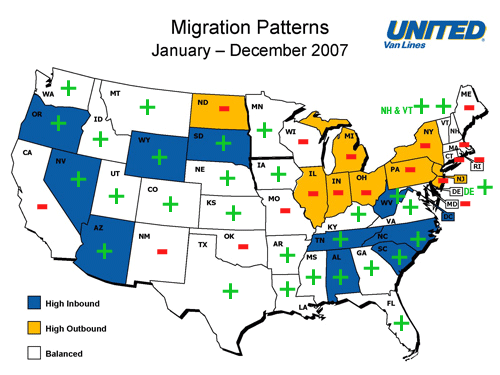
Unfortunately, it appears that our next president will be from Illinois or New York, two of the eight states the local government has screwed up so bad that no one wants to do business there any more. I guess both Hillary and Obama can claim that their states have licked the immigration problem bay increasing taxes and regulation so much that no one wants to come to their states any more.
Sunday, February 17, 2008
We Just Love This Guy. Bookmark His Site!


Friday, February 15, 2008

Thursday, February 14, 2008
The Past Is, Like, Sooo - Yesterday

Man, this is so Funny -
click here for the audio of a Rush Limbaugh's fake ad for Obama.
There's another one here.
The gist is "the future not the past", "change is good", "hope is good" and stuff like that there.
Moonies For Obama

This is starting to get scary. In case you haven't guessed, that is Obama that she's mooning over.
Tuesday, February 12, 2008
Quote Of The Day
 Sir Winston Churchill
"Men occasionally stumble over the truth, but most of them pick themselves up and hurry off as if nothing ever happened."
Monday, February 11, 2008
And The (book sales) Votes Are In!

According to Nielsen BookScan, which tracks about 70 percent of industry sales, Hillary Clinton's Living History averaged around 1,000 sales a week in December and early January, compared to more than 7,000 a week for Obama's Audacity of Hope and more than 2,000 for his other book, Dreams From My Father.
Another Prong In The Fork

In another thinly veiled step toward creating a "Greater Eureka Park District", the Eureka City Council approved $25,000 for the "study" of building a swimming and water entertainment facility.
Did the city of Eureka ever fix all of the water and sewer infrastructure problems which were plaguing the system a few years ago? It seems to us that there were over 5 miles of mains and pipes to be replaced at a cost of nearly $3 millions.
If not, perhaps that would be a better place to spend that money. If so, perhaps they could pay off those bonds before issuing more for a pool.
Then again, maybe they are planning to collect all of the water leaking out of the municipal water supply and fill the pool with it.
We understand that there are gambling tax revenues to be had from the suburban Chicago horse racing facilities with the formation of a "proper" park district. However, we wonder if creating another administrative tax district with its attendant salaries and pensions spread out upon the backs of the property tax payers in (what has always been discussed as the base for this) the District 140 wide area is the proper road for the city of Eureka.
Usually a fork has four prongs. We now have the ball fields and programs, the "dog park", and the pool. What is the final prong on this latest fork to be stuck into the property tax trough? Perhaps a nice Eureka Civic Center? We'll find out soon enough.
Did the city of Eureka ever fix all of the water and sewer infrastructure problems which were plaguing the system a few years ago? It seems to us that there were over 5 miles of mains and pipes to be replaced at a cost of nearly $3 millions.
If not, perhaps that would be a better place to spend that money. If so, perhaps they could pay off those bonds before issuing more for a pool.
Then again, maybe they are planning to collect all of the water leaking out of the municipal water supply and fill the pool with it.
We understand that there are gambling tax revenues to be had from the suburban Chicago horse racing facilities with the formation of a "proper" park district. However, we wonder if creating another administrative tax district with its attendant salaries and pensions spread out upon the backs of the property tax payers in (what has always been discussed as the base for this) the District 140 wide area is the proper road for the city of Eureka.
Usually a fork has four prongs. We now have the ball fields and programs, the "dog park", and the pool. What is the final prong on this latest fork to be stuck into the property tax trough? Perhaps a nice Eureka Civic Center? We'll find out soon enough.
Friday, February 08, 2008
Castle or Yoke?
Guest Editorial: How can a man’s home be his castle, if a man’s house is a heavy yoke around his neck?
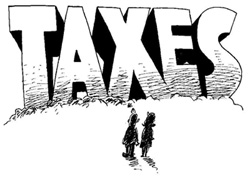 In his work, “Democracy in America,” Alexis de Tocqueville notes, “A democratic government is the only one in which those who vote for a tax can escape the obligation to pay it,” and he questions whether a free society can long survive that discovery. Obviously that discovery has been made, for many more are eligible to vote than are required to pay, and many who are required to pay are required to pay more than they can afford. Is this what the founders of this Democracy in America sacrificed their fortunes and lives to secure? I think not!
Now it is true that the descendents of the agents of old King George live on in Washington and Springfield, and they tax much more than tea.
But it is the reincarnations of those more notorious Tax collectors of Biblical fame who reside in our local seats of government. In like manner as those who confiscated in the name of Caesar and Herod, these publicans attach themselves not only to the current fruit of our labor, but they also have the audacity to lay claim to the essential roofs over our heads. Apparently, each June and September, these fellow citizens of ours have nothing better to do than enter our private dwellings and demand the silverware.
We have not yet been compelled to sell our sons and daughters into servitude to meet their annually increasing levies against our family homes. But, like the peasants of old in Palestine, many of us have had to mortgage our houses and lands to pay these taxes, and any of us who cannot pay the last farthing will shortly find our persons and kin thrown out into the street.
And what do they use these forcibly collected monies for? Some for services to the common good, too be sure. But much of it is used to built monuments to themselves; Civic Centers, airports, office buildings, and courthouses. And of course they must always be constructing bigger and better facilities in which to secularize our children, much as the Herods of old used the taxes from the Jewish people to forcibly Hellenize their culture.
The income taxes of the current King George, while not born by all, are at least only a one-time levy on our annual increase. The sales taxes of his vassal Rob are at least a levy on the consumption of all of us, (and on luxuries which are occasionally enjoyed by even the common citizen if he has a little something left over after paying his taxes.)
But the Real Estate Tax is Regressive and Oppressive. It is a tax, not on earnings but on principle. It is a tax not on spending but on savings. It is a tax, not on the peripherals of living but on the essential of family life. It is an ever recurring and increasing levy on false and inflated home values that has to be paid with the real sweat of real brows.
Presidential candidate Clinton has recently called for moratorium on foreclosures. What is needed is the abolition of one of the causes of these personal and family catastrophes – the Real Estate tax on private family homes.
Dennis W Dillard
Hanna City, IL
Wednesday, February 06, 2008

Monday, February 04, 2008

You Think That's Big?

The Woodford County wind turbines are rated some where around 1.6 Megawatts per unit and just under 400 feet tall. "That's Nothin'" say the French. Or would is be "c'est zero"?
The world’s largest wind turbine is now the Enercon E-126. This turbine has a rotor blade width of 413 feet. The E-126 is a more sophisticated version of the E-112, formerly the world’s largest wind turbine and rated at 6 megawatts.
This new turbine is officially rated at 6 megawatts too, but will mostly likely produce 7+ megawatts (or 20 million kilowatt hours per year). That’s enough to power about 1,775 American homes per year on one wind turbine.
The world’s largest wind turbine is now the Enercon E-126. This turbine has a rotor blade width of 413 feet. The E-126 is a more sophisticated version of the E-112, formerly the world’s largest wind turbine and rated at 6 megawatts.
This new turbine is officially rated at 6 megawatts too, but will mostly likely produce 7+ megawatts (or 20 million kilowatt hours per year). That’s enough to power about 1,775 American homes per year on one wind turbine.
Friday, February 01, 2008
Caroline Schertz "Objects" To PTELL

Caroline Schertz "Explains" opposition To PTELL In this video, Ms. Schertz (running for reelection to District 3 - Woodford County Board) gives her rationale for voting last August to prevent PTELL from appearing before the voters this Tuesday. For more information on this vote, please look here.
Don't forget to vote the 5th (if you haven't voted early)!
Jim Irvin and Bob Huschen Argue For County Board PTELL Vote
 Here are some comments from the August Board meeting recommending that the Woodford County Board put PTELL before the voters next Tuesday.
Click here for Mr. Irvin's comments.
Click here for Mr. Huschen's comments.
The Board did not comply. Please see the prior post for more information.
Thursday, January 31, 2008
Gary Joseph/Tom Karr "Explain" Opposition To PTELL

Gary Joseph (running for reelection to District 2 - Woodford County Board) and Tom Karr (running for reelection to District 3 - Woodford County Boar) give the rationales for their votes last August preventing PTELL from appearing before the voters this Tuesday in this video.
For more information on this vote, please look here.
Coming up next, the Caroline Schertz (running for reelection to District 3 - Woodford County Board) video.
Wednesday, January 30, 2008

Tuesday, January 29, 2008
Agflation And The End Of Cheap Food

This from the 12-06-2007 print edition of "The Economist":
Rising food prices are a threat to many; they also present the world with an enormous opportunity
FOR as long as most people can remember, food has been getting cheaper and farming has been in decline. In 1974-2005 food prices on world markets fell by three-quarters in real terms. Food today is so cheap that the West is battling gluttony even as it scrapes piles of half-eaten leftovers into the bin.
That is why this year's price rise has been so extraordinary. Since the spring, wheat prices have doubled and almost every crop under the sun—maize, milk, oilseeds, you name it—is at or near a peak in nominal terms. The Economist's food-price index is higher today than at any time since it was created in 1845 (see chart). Even in real terms, prices have jumped by 75% since 2005. No doubt farmers will meet higher prices with investment and more production, but dearer food is likely to persist for years (see article). That is because “agflation” is underpinned by long-running changes in diet that accompany the growing wealth of emerging economies—the Chinese consumer who ate 20kg (44lb) of meat in 1985 will scoff over 50kg of the stuff this year. That in turn pushes up demand for grain: it takes 8kg of grain to produce one of beef.
But the rise in prices is also the self-inflicted result of America's reckless ethanol subsidies. This year biofuels will take a third of America's (record) maize harvest. That affects food markets directly: fill up an SUV's fuel tank with ethanol and you have used enough maize to feed a person for a year. And it affects them indirectly, as farmers switch to maize from other crops. The 30m tonnes of extra maize going to ethanol this year amounts to half the fall in the world's overall grain stocks.
Dearer food has the capacity to do enormous good and enormous harm. It will hurt urban consumers, especially in poor countries, by increasing the price of what is already the most expensive item in their household budgets. It will benefit farmers and agricultural communities by increasing the rewards of their labour; in many poor rural places it will boost the most important source of jobs and economic growth.
Although the cost of food is determined by fundamental patterns of demand and supply, the balance between good and ill also depends in part on governments. If politicians do nothing, or the wrong things, the world faces more misery, especially among the urban poor. If they get policy right, they can help increase the wealth of the poorest nations, aid the rural poor, rescue farming from subsidies and neglect—and minimise the harm to the slum-dwellers and landless labourers. So far, the auguries look gloomy.
In the trough
That, at least, is the lesson of half a century of food policy. Whatever the supposed threat—the lack of food security, rural poverty, environmental stewardship—the world seems to have only one solution: government intervention. Most of the subsidies and trade barriers have come at a huge cost. The trillions of dollars spent supporting farmers in rich countries have led to higher taxes, worse food, intensively farmed monocultures, overproduction and world prices that wreck the lives of poor farmers in the emerging markets. And for what? Despite the help, plenty of Western farmers have been beset by poverty. Increasing productivity means you need fewer farmers, which steadily drives the least efficient off the land. Even a vast subsidy cannot reverse that.
With agflation, policy has reached a new level of self-parody. Take America's supposedly verdant ethanol subsidies. It is not just that they are supporting a relatively dirty version of ethanol (far better to import Brazil's sugar-based liquor); they are also offsetting older grain subsidies that lowered prices by encouraging overproduction. Intervention multiplies like lies. Now countries such as Russia and Venezuela have imposed price controls—an aid to consumers—to offset America's aid to ethanol producers. Meanwhile, high grain prices are persuading people to clear forests to plant more maize.
Dearer food is a chance to break this dizzying cycle. Higher market prices make it possible to reduce subsidies without hurting incomes. A farm bill is now going through America's Congress. The European Union has promised a root-and-branch review (not yet reform) of its farm-support scheme. The reforms of the past few decades have, in fact, grappled with the rich world's farm programmes—but only timidly. Now comes the chance for politicians to show that they are serious when they say they want to put agriculture right.
Cutting rich-world subsidies and trade barriers would help taxpayers; it could revive the stalled Doha round of world trade talks, boosting the world economy; and, most important, it would directly help many of the world's poor. In terms of economic policy, it is hard to think of a greater good.
Where government help is really needed
Three-quarters of the world's poor live in rural areas. The depressed world prices created by farm policies over the past few decades have had a devastating effect. There has been a long-term fall in investment in farming and the things that sustain it, such as irrigation. The share of public spending going to agriculture in developing countries has fallen by half since 1980. Poor countries that used to export food now import it.
Reducing subsidies in the West would help reverse this. The World Bank reckons that if you free up agricultural trade, the prices of things poor countries specialise in (like cotton) would rise and developing countries would capture the gains by increasing exports. And because farming accounts for two-thirds of jobs in the poorest countries, it is the most important contributor to the early stages of economic growth. According to the World Bank, the really poor get three times as much extra income from an increase in farm productivity as from the same gain in industry or services. In the long term, thriving farms and open markets provide a secure food supply.
However, there is an obvious catch—and one that justifies government help. High prices have a mixed impact on poverty: they hurt anyone who loses more from dear food than he gains from a higher income. And that means over a billion urban consumers (and some landless labourers), many of whom are politically influential in poor countries. Given the speed of this year's food-price rises, governments in emerging markets have no alternative but to try to soften the blow.
Where they can, these governments should subsidise the incomes of the poor, rather than food itself, because that minimises price distortions. Where food subsidies are unavoidable, they should be temporary and targeted on the poor. So far, most government interventions in the poor world have failed these tests: politicians who seem to think cheap food part of the natural order of things have slapped on price controls and export restraints, which hurt farmers and will almost certainly fail.
Over the past few years, a sense has grown that the rich are hogging the world's wealth. In poor countries, widening income inequality takes the form of a gap between city and country: incomes have been rising faster for urban dwellers than for rural ones. If handled properly, dearer food is a once-in-a-generation chance to narrow income disparities and to wean rich farmers from subsidies and help poor ones. The ultimate reward, though, is not merely theirs: it is to make the world richer and fairer.
The emphases are ours.
So go ahead and chow down and fill up with E85 on the way.
It'll only hurt when you laugh.
Sunday, January 27, 2008

Tuesday, January 08, 2008
Woodford County Factoids

The median home value in Woodford County, IL, is $191,500. Home appreciation is 0.22% over the last year. The median age of Woodford County, IL, real estate is 36 years.
Woodford County, IL Apartments and Rentals
Renters make up 16.12% of the Woodford County, IL, population. 5.12% of houses and apartments in Woodford County, IL, are unoccupied (vacancy rate).
The emphases are our own. That's not 22% (for those in Rio Linda as someone would say). That's POINT 22 percent. What is the rationale (you've heard the line; you're property value has been growing Soooo Fast) for property tax increases of 7, 8, 10 percent for various taxing authorities in light of the above stats?
Friday, January 04, 2008
Iowa's "One-Two-Threes"

The Iowa "caucuses" are an interesting thing to behold, aren't they?
The Democrat "caucus" is really more interesting than the Republican Iowa "Straw" poll in that the Democrat process involves debate amongst the "caucus-goers" whereas the Republican demonstration is simply a pretend "vote".
Let's examine the Democrat 1-2-3 results:
Barrack Obama - attorney, one term U.S. Senator (running against Alan Keyes - arguably a "carpet-bagger" to Illinois in that election - similar to H. Clinton in New York [see below]), Illinois Congressman
John Edwards - attorney, one term U.S. Senator; professional U.S. presidential candidate
Hillary Clinton - attorney, one and a half term U.S. Senator - New York (not, we may add any state where she actually resided for a length of time like, Arkansas, or Illinois, or Washington D.C., nor Delaware; New York - ) the only place she could win a Senate seat in this country at that time; professional U.S. presidential candidate
The Republican 1-2-3 Iowa results:
Mike Huckabee - Southern-Baptist Minister, 11 year Governor of Arkansas
Fred Thompson - U.S. Senator - eight years; professional actor; attorney
Mitt Romney - one term Governor of Massachusetts, private Equity capital manager/business owner; CEO of 1992 U.S. Olympics;
we should also add the Republican "#4" just to add to the contrasts:
John McCain - U.S. Military; one term U.S. congressman; Senior Senator from Arizona - 1986 - present; Vietnam war POW
There are a lot of attorneys from Illinois on the Democrat side, huh? How's that Democrat Illinois House, Senate, and Executive working out for you folks? O.K? Pretty satisfied with that?
Want that Washington scene to resemble Springfield? I think your choice is clear.
The Democrat "caucus" is really more interesting than the Republican Iowa "Straw" poll in that the Democrat process involves debate amongst the "caucus-goers" whereas the Republican demonstration is simply a pretend "vote".
Let's examine the Democrat 1-2-3 results:
Barrack Obama - attorney, one term U.S. Senator (running against Alan Keyes - arguably a "carpet-bagger" to Illinois in that election - similar to H. Clinton in New York [see below]), Illinois Congressman
John Edwards - attorney, one term U.S. Senator; professional U.S. presidential candidate
Hillary Clinton - attorney, one and a half term U.S. Senator - New York (not, we may add any state where she actually resided for a length of time like, Arkansas, or Illinois, or Washington D.C., nor Delaware; New York - ) the only place she could win a Senate seat in this country at that time; professional U.S. presidential candidate
The Republican 1-2-3 Iowa results:
Mike Huckabee - Southern-Baptist Minister, 11 year Governor of Arkansas
Fred Thompson - U.S. Senator - eight years; professional actor; attorney
Mitt Romney - one term Governor of Massachusetts, private Equity capital manager/business owner; CEO of 1992 U.S. Olympics;
we should also add the Republican "#4" just to add to the contrasts:
John McCain - U.S. Military; one term U.S. congressman; Senior Senator from Arizona - 1986 - present; Vietnam war POW
There are a lot of attorneys from Illinois on the Democrat side, huh? How's that Democrat Illinois House, Senate, and Executive working out for you folks? O.K? Pretty satisfied with that?
Want that Washington scene to resemble Springfield? I think your choice is clear.
Tuesday, December 18, 2007
N.Y. Times Says End Property Tax

John Brady, Op-Ed. contributor to the Regional/N.Y. edition of the Times says, among other things:
The property tax is a concept whose better days are behind it. It concentrates on one asset while ignoring income. Two people in similar homes pay the same tax — even if one lives on Social Security and the neighbor makes a huge salary and has millions in stocks . . .
The most obvious drawback of the current property tax system is that since it ignores a person’s income, it causes undue hardship for retired people and those going through tough times. As baby boomers, many of whom have no defined-benefit pension plan, begin to retire in huge numbers, thousands in Connecticut will be forced out of their homes — and most likely out of the state since affordable housing isn’t easy to come by here . . .
The property tax is ready for retirement. Somewhere there has to be an imaginative public official who can come up with an answer to the problem. Whether it is a simplified municipal income tax or something else, we need a solution.
You may read the full piece here.
Subscribe to:
Posts (Atom)

We moved here and bought a 100yr old house on 1 1/2 acres in the Washburn/Lowpoint area in Ocotber of 06. This house was last sold in 1990 . Our 06 tax bill was $1400 and some change. We've just received a notice of revised tax assessment . The previous equalized value assessed in 06 was 23,500 and there had been NO work or improvements done to this house since septic was put in in late 05 by previous owners . The NEW equalized assessment for 07 is 64,230--meaning our 07 bill will be almost 5,000 !!Thats like a 300% increase ! Weve heard we have the worst schools and thought we'd have the lowest taxes around in Woodford county ?(We homeschool 7 children and live on one income).
To top all this off we found out a few months after buying this house that they are going to widen the road and will be taking it all from our side . Our home is already very close to the road and in essence doing this they will be destroying ANY value our home has--and yet they are raising our taxes by 300%. We feel like we've been hit by a semi in all of this and don't quite know what to do. Any thoughts?